
Fiberglass reinforced plastic (FRP) pipes are becoming increasingly popular in industries like wastewater treatment, chemical transport, desalination, and irrigation. One of the main reasons behind their reliability and performance is the manufacturing method used to produce them—filament winding.
If you’ve ever wondered how does an FRP pipe filament winding machine work, you’re not alone. Many engineers, plant managers, and investors who enter the composite industry ask the same question. From the outside, the equipment looks complex, but the basic idea is actually quite straightforward.
In this guide, I’ll walk you through the entire process in a practical and easy-to-understand way. We’ll look at the machine structure, the production steps, and why this technology is widely used in FRP pipe manufacturing today.
Understanding the Basics of FRP Pipe Filament Winding
Before we dive into the details, let’s quickly clarify the concept.
Filament winding is a manufacturing process where continuous fiberglass strands are coated with resin and wound around a rotating mold (called a mandrel). These layers gradually build up to form the pipe wall.
When people ask how does an FRP pipe filament winding machine work, they’re essentially asking how the machine controls this fiber placement so precisely.
The answer lies in automation. Modern machines use synchronized motion systems and computer control to guide the fibers in specific patterns that give the pipe strength in different directions.
Key Components of an FRP Pipe Filament Winding Machine
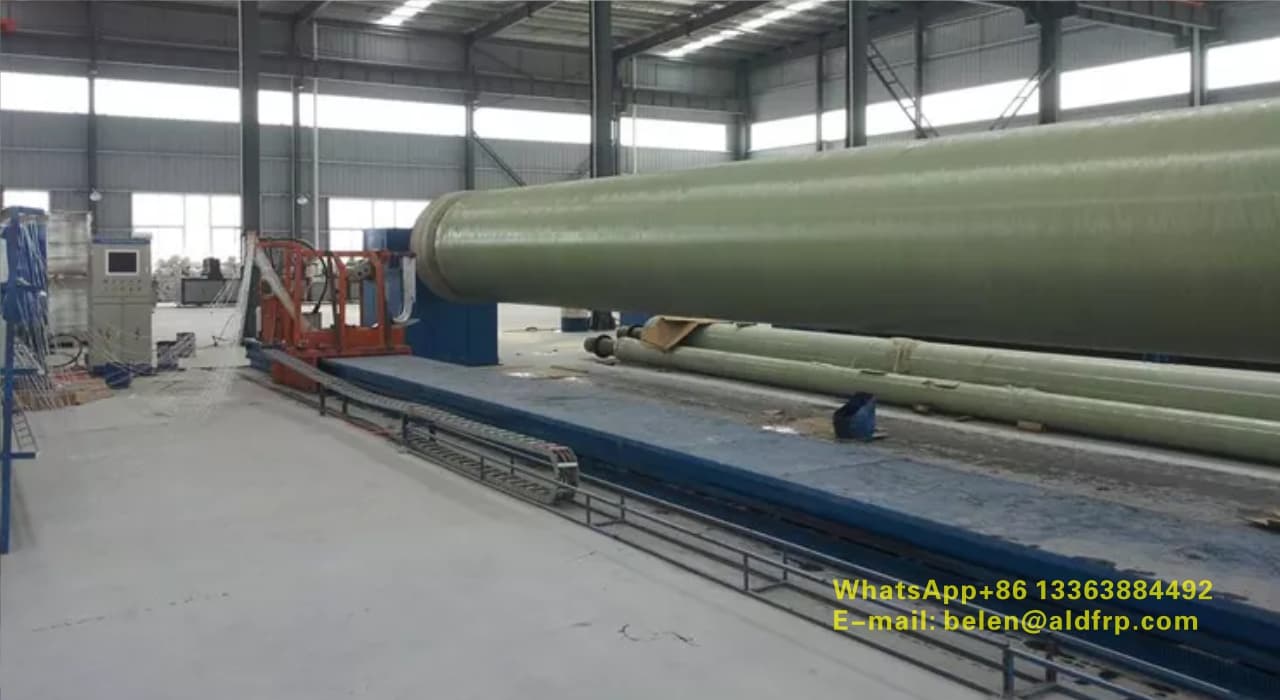
To understand how does an FRP pipe filament winding machine work, we first need to look at the major parts of the equipment.
1. Mandrel System
The mandrel is the cylindrical mold that determines the pipe’s inner diameter.
It rotates during production while fibers are wound onto its surface. Mandrels are usually made of steel and designed to withstand continuous operation.
Before production begins, the mandrel is coated with a release agent so the finished pipe can be removed easily.
2. Fiber Creel
The fiber creel holds multiple spools of fiberglass rovings. These continuous strands of glass fiber are the primary reinforcement material used in FRP pipes.
The fibers are fed into the winding system with carefully controlled tension. If the tension fluctuates too much, it could weaken the pipe structure.
3. Resin Impregnation System
Fiberglass alone isn’t enough to form a composite structure. The fibers must be combined with resin.
In the resin impregnation system, the fibers pass through a resin bath or injection chamber where they are fully saturated.
Common resins used include:
-
Polyester resin
-
Vinyl ester resin
-
Epoxy resin
This step ensures the fibers bond together once curing occurs.
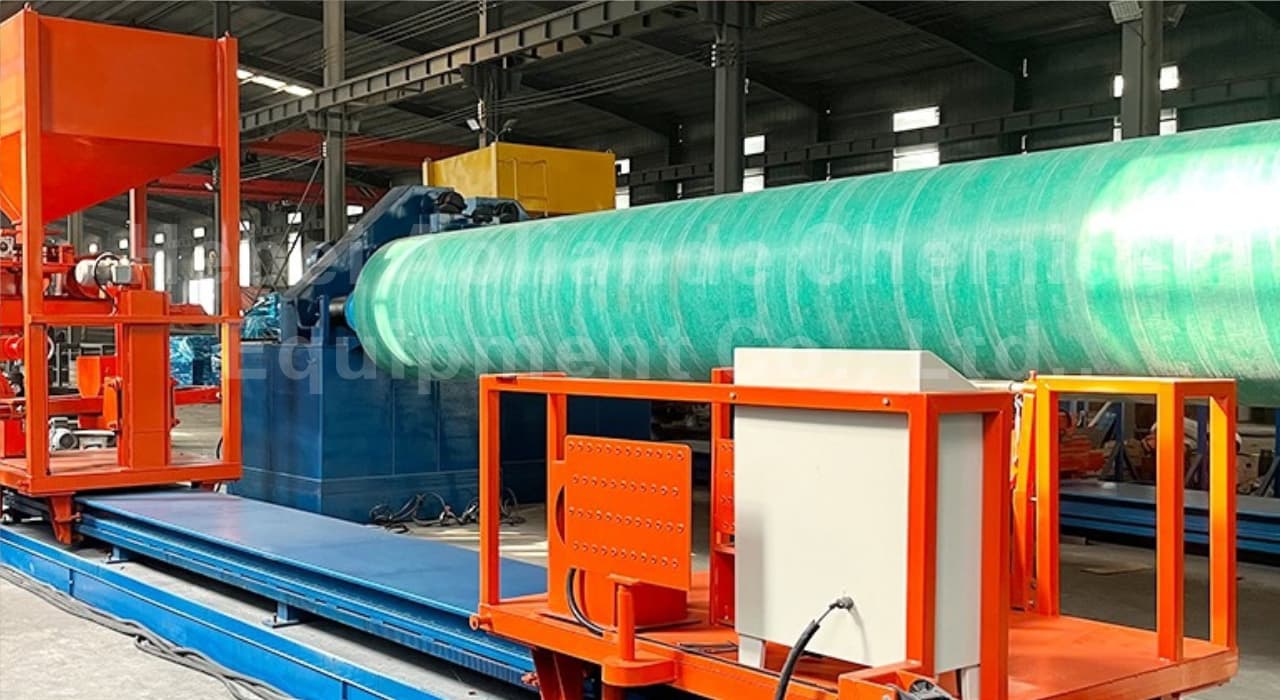
4. Winding Carriage
The winding carriage is one of the most important moving parts of the machine.
While the mandrel rotates, the carriage moves back and forth along its length, placing fibers in precise patterns. This synchronized motion determines the winding angle.
The accuracy of this system is critical when explaining how does an FRP pipe filament winding machine work, because fiber angle directly affects pipe strength.
5. Control System
Modern filament winding machines use CNC or PLC control systems.
These systems manage:
-
Mandrel rotation speed
-
Fiber tension
-
Carriage movement
-
Winding angles
-
Layer thickness
Operators can program different pipe designs into the system and reproduce them consistently.
Step-by-Step: How the Filament Winding Process Works
Now that we understand the machine structure, let’s walk through the production process.
This will make it much clearer how does an FRP pipe filament winding machine work in a real manufacturing environment.
Step 1: Preparing the Mandrel
Production begins by installing the mandrel onto the machine’s rotating drive system.
A release agent is applied to the surface so that the cured pipe can be removed later without damage.
In many factories, this preparation step is quick but very important. If the release agent is not applied properly, demolding can become difficult.
Step 2: Fiber Feeding
Next, fiberglass rovings are loaded onto the creel.
The fibers are guided through tension control devices and then directed toward the resin impregnation unit.
Stable fiber tension ensures consistent material distribution across the pipe wall.
Step 3: Resin Impregnation
Before the fibers reach the mandrel, they pass through the resin bath.
This is where they absorb the resin that will later harden and bind them together.
At this stage, operators must carefully control:
-
Resin viscosity
-
Fiber saturation level
-
Resin-to-fiber ratio
These factors influence the final mechanical properties of the pipe.
Step 4: Filament Winding
Now comes the core stage of the process.
The mandrel rotates while the winding carriage travels along its length. The resin-coated fibers are applied in controlled patterns.
Different winding angles provide different types of strength.
Hoop winding
Fibers are placed almost perpendicular to the pipe axis. This improves resistance to internal pressure.
Helical winding
Fibers are applied at an angle, strengthening the pipe against axial forces.
Manufacturers often combine these two patterns.
This stage clearly shows how does an FRP pipe filament winding machine work, because the machine’s synchronization allows thousands of fibers to be positioned accurately.
Step 5: Building the Pipe Structure
FRP pipes usually have a multi-layer structure.
Typical layers include:
-
Inner corrosion-resistant liner
-
Structural reinforcement layers
-
Outer protective layer
Some production lines also add quartz sand between fiberglass layers. This increases stiffness and reduces material costs.
The machine continues winding until the required wall thickness is achieved.
Step 6: Resin Curing
Once winding is finished, the pipe must cure.
During curing, the resin undergoes a chemical reaction that hardens the composite structure.
Curing can happen through:
-
Ambient temperature curing
-
Heated ovens
-
Infrared heating systems
This step transforms the wound fibers into a rigid, durable pipe.
Step 7: Demolding the Pipe
After curing, the finished pipe must be removed from the mandrel.
Hydraulic extraction systems or mechanical pulling devices are often used for this step.
Because the mandrel was coated earlier with release agent, the pipe can slide off without damaging the inner surface.
Step 8: Cutting and Finishing
The final step involves preparing the pipe for use.
Typical finishing processes include:
-
Cutting the pipe to standard lengths
-
Trimming the edges
-
Surface inspection
-
Pressure testing
At this stage, the pipe is ready for installation or shipment.
Why Filament Winding Is So Popular
Understanding how does an FRP pipe filament winding machine work also helps explain why the technology is so widely used.
Here are some key advantages.
Consistent quality
Automated control systems ensure precise fiber placement.
High strength
The controlled winding angles provide excellent structural performance.
Efficient material use
The process reduces waste compared with traditional fabrication methods.
Flexible pipe design
Manufacturers can easily adjust diameter, wall thickness, and reinforcement.
Real-World Applications of FRP Pipes
Pipes produced using filament winding technology are used in many industries.
Common applications include:
-
Wastewater treatment plants
-
Chemical transport pipelines
-
Seawater desalination systems
-
Cooling water pipelines in power plants
-
Irrigation systems
Their corrosion resistance makes them especially useful in harsh environments where steel pipes would degrade quickly.
أفكار نهائية
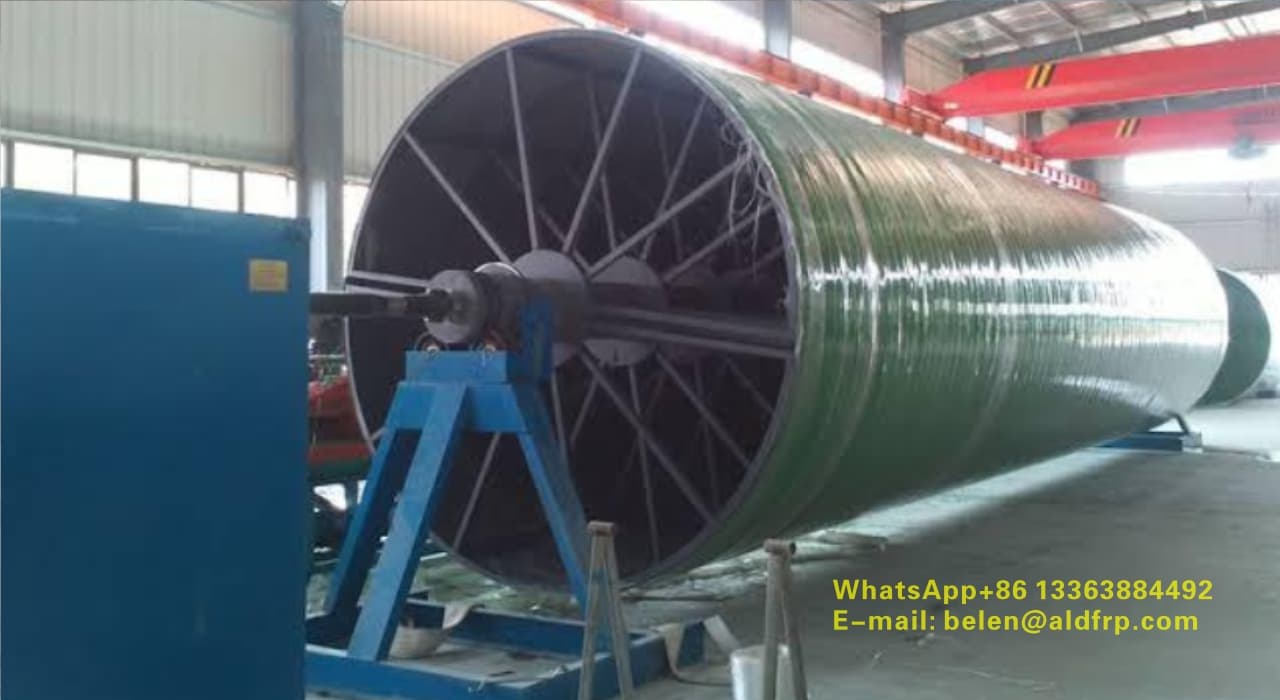
So, how does an FRP pipe filament winding machine work?
In simple terms, the machine precisely winds resin-coated fiberglass fibers around a rotating mandrel to build a strong composite pipe layer by layer. Through synchronized motion, automated control systems, and controlled curing, the process produces durable pipes that can last for decades.
For manufacturers entering the composite industry, understanding this process is the first step toward building an efficient and competitive FRP pipe production line.
As global demand for corrosion-resistant infrastructure continues to grow, filament winding technology will remain one of the most important manufacturing methods in the fiberglass pipe industry.