
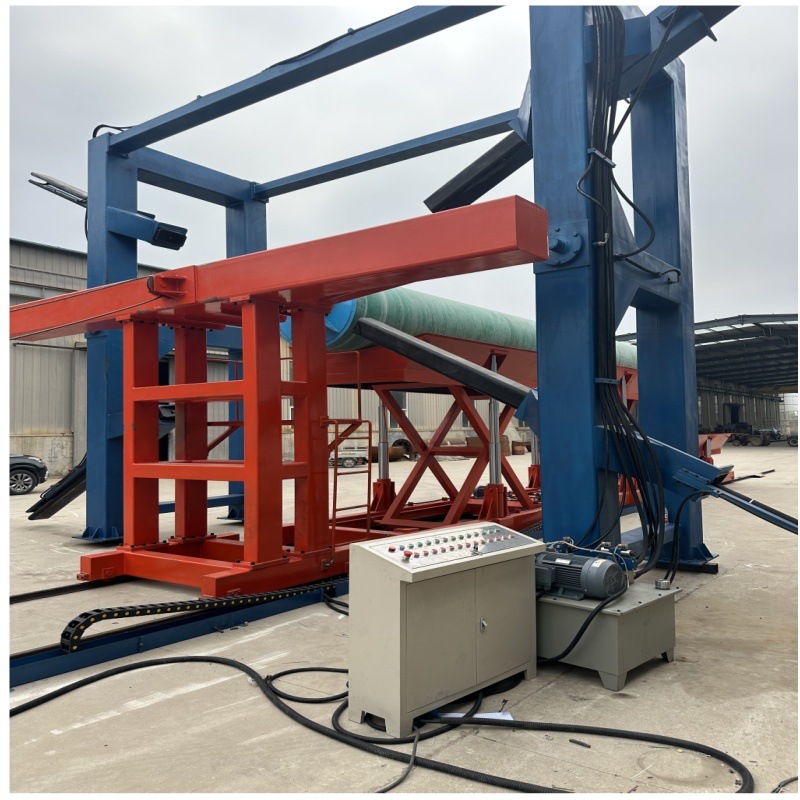
For many pipe manufacturers, the real question is not whether an FRP pipe filament winding machine can make pipes. It can. The real question is whether the investment will pay back fast enough to justify the move from manual or semi-automatic production.
That is where ROI matters. A modern FRP pipe production line can change daily output, labor use, product consistency, scrap rate, and the range of pipe sizes a factory can sell. On paper, the machine is a capital purchase. In practice, it affects cost per meter, delivery speed, and margin on every order. Hebei Aoliande provides a computer-controlled line built around inner liner making, winding, curing, trimming, demoulding, and resin mixing, while its company profile says the firm supplies multiple FRP production systems and has ISO9001, ISO14001 and OHSAS18001 certifications, 300 staff, and overseas sales.
What Is an FRP Pipe Filament Winding Machine?
Before looking at cost and payback, it helps to define the process clearly.
An FRP pipe winding machine is a manufacturing system that places continuous fiberglass rovings onto a rotating mandrel, adds resin, builds the pipe wall layer by layer, and then cures the structure into a finished pipe. The basic process usually includes mandrel preparation, resin impregnation, fiber winding, curing, and removal from the mandrel. Modern systems also control fiber tension, winding angle, carriage motion, and layer thickness.
That technical sequence matters because pipe performance depends heavily on repeatability. A pipe line that can hold stable winding angles and stable wall build is far better at producing consistent pressure-bearing and corrosion-resistant products than a workshop that relies mostly on manual judgment.
The main parts that affect output and quality
A buyer looking at ROI should pay attention to the parts of the line that directly change production speed and defect rate:
- Mandrel system
- Fiber creel and resin impregnation system
- Winding carriage
- Computer control system
- Curing station
- Demoulding and trimming section
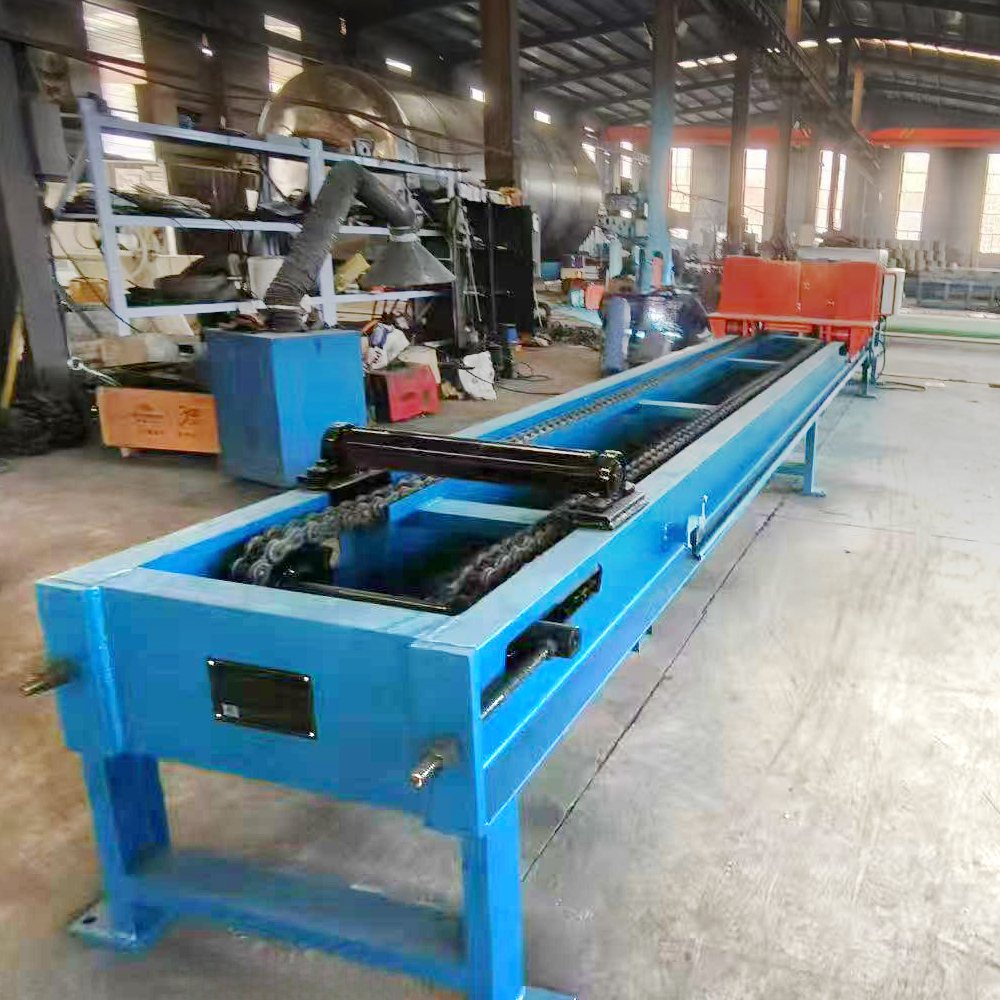
These sections are standard to the winding process, and Aoliande’s FRP pipe line provides a similar multi-part structure built around liner making, winding, curing, trimming, demoulding, and resin mixing.
Why ROI Matters More Than Machine Price
 Many procurement discussions still start with one narrow question: “What is the machine price?” That question is incomplete.
A lower upfront price does not always mean a lower production cost. If the line consumes more labor, wastes more resin and fiberglass, or produces a higher reject rate, the apparent savings disappear quickly. Search results and industry pages that rank well on this topic tend to focus on the same pattern: they explain the process first, then link machine choice to automation, output, precision, and operating cost. That structure reflects how real buyers think. The line is not just equipment. It is a cost structure.
ROI in pipe manufacturing usually comes from five places
Most factories see return from a new FRP pipe manufacturing machine through a mix of these factors:
| ROI driver | How it affects profit |
|---|---|
| Labor reduction | Fewer operators per shift and less dependence on highly experienced manual workers |
| Higher output | More meters produced per day and more orders completed on time |
| Lower waste | Better control of fiber placement, resin use, and wall thickness |
| Better consistency | Fewer rejected pipes, less rework, fewer customer complaints |
| Wider product range | Ability to bid on more sizes and project types |
This is why a serious FRP machine investment should be measured against annual net gain, not against sticker price alone.
The Cost Side of an FRP Pipe Production Line
No ROI discussion is credible without a realistic look at cost.
A complete pipe filament winding machine project usually includes more than the winding unit itself. There is also installation, operator training, utilities, raw material handling, maintenance, spare parts, and downtime during commissioning. Aoliande’s equipment pages show that a pipe line can include several connected stations rather than a single standalone machine, which is a useful reminder for budget planning.
Cost items buyers often miss
Some costs are obvious. Others are easy to overlook until the machine is already on the factory floor.
Direct investment cost: this includes the machine line, auxiliary equipment, shipping, installation, and start-up support.
Production cost: this covers resin, fiberglass rovings, fillers, electricity, labor, maintenance, and consumables.
Hidden cost: this includes scrap pipe, failed pressure tests, unstable dimensions, late deliveries, and idle hours caused by poor coordination between machine sections.
A factory that tracks only machine purchase price will usually get the ROI calculation wrong.
Where the Return Really Comes From
The strongest ROI usually does not come from one dramatic saving. It comes from steady gains across the whole line.
Factories that move to computer-controlled filament winding usually do so for the same reasons: labor is getting more expensive, customers want stable quality, and order schedules are tighter than before. Compared to traditional winding methods, computer control effectively reduces human error and enhances operational precision by precisely regulating the winding speed, fiber pull, and angle changes through programmed operation. Another industry supplier page highlights full automation and cost-effective production as key selling points for FRP pipe lines.
Labor savings
Manual or semi-automatic production depends heavily on operators with practical experience. That creates two risks. First, labor cost rises. Second, output stability changes when staff changes.
A computer-controlled FRP pipe winding machine reduces those risks. Fewer manual corrections are needed during winding. New staff can be trained faster. Shift-to-shift differences become smaller.
Material savings
Fiberglass and resin are not cheap. Even a small drop in waste has a clear annual effect when output volume is high.
Stable control over winding angle, tension, and wall build helps reduce:
- overuse of resin
- uneven wall thickness
- localized weak zones
- rework after inspection
Higher daily output
Output is one of the easiest ROI drivers to see. When winding, curing, and demoulding are organized as a system instead of separate manual steps, the factory can move more pipe through the line each shift.
That matters most in busy seasons, on municipal supply projects, and in export business where delivery dates are strict.
How to Calculate FRP Pipe Filament Winding Machine ROI
The simplest formula is still useful:
ROI (%) = Annual net gain ÷ Total investment × 100
Payback period = Total investment ÷ Annual net cash benefit
The value of this approach is not the formula itself. The value is that it forces the factory to collect real production numbers before buying.
A practical ROI example
Here is a simple model for a mid-sized pipe factory:
| Artículo | Annual impact |
|---|---|
| Labor saving | $60,000 |
| Scrap and rework reduction | $35,000 |
| Extra margin from higher output | $110,000 |
| Maintenance and added running cost | -$20,000 |
| Net annual gain | $185,000 |
If the total investment is $370,000, the payback period is about 2 years.
The exact number changes by labor cost, order volume, pipe size mix, and selling price. Still, the model shows why the right question is not “How much does the machine cost?” but “How much cash does the line add or save each year?”
Numbers a buyer should collect before making a decision
A serious ROI calculation needs plant data, not guesswork. At minimum, the factory should know:
- current output per day
- average reject rate
- labor cost per shift
- resin and fiberglass consumption per pipe size
- average order backlog
- gross margin by pipe category
Without those numbers, even the best FRP equipment ROI discussion becomes theory.
Manual Production vs Computer-Controlled Winding
This comparison matters because many factories are not starting from zero. They already make pipes, but not at the scale or consistency they want.
The difference is not only speed. It is control.
Manual or semi-automatic production often struggles with:
- variable winding quality
- higher dependence on operator skill
- slower changeovers
- more scrap during long runs
- weaker repeatability on larger diameters
Computer-controlled winding is stronger at:
- repeatable winding paths
- stable wall thickness
- easier recipe storage
- lower defect risk in repeat orders
- better fit for large project volumes
Those are the points buyers keep searching for because they connect directly to ROI.
Which Factories Usually See Faster Payback?
Not every plant gets the same return at the same speed.
A pipe line investment tends to pay back faster in factories with stable order flow, large-diameter demand, or rising labor pressure. It also pays back faster where customers require more reliable delivery and more consistent product quality.
Faster payback is common when the factory:
- supplies municipal water or drainage projects
- makes corrosion-resistant pipes for chemical or industrial use
- wants to expand into larger diameters
- struggles with high labor turnover
- loses margin through rework and material waste
Industry pages on FRP and GRP pipe production commonly highlight automation, large diameter flexibility, and cost-effective output as core business benefits rather than just machine features.
A Brief Look at Hebei Aoliande Chemical Equipment Co., LTD.
Before drawing the final conclusion, it is useful to place the supplier in context.
Hebei Aoliande Equipo Químico Co., LTD. presents itself as a manufacturer of FRP pipe filament winding machines, FRP tank filament winding machines, and other FRP production equipment. Its website says the company has passed ISO9001, ISO14001, and OHSAS18001 management system certifications, employs about 300 staff, and sells products to markets including the United States, Brazil, Japan, Germany, India, Malaysia, Iran, and Egypt. The company’s product categories also show a broader FRP equipment portfolio, which can be useful for buyers looking for a supplier with experience across related composite manufacturing systems.
Conclusión
An FRP pipe filament winding machine is not just a production upgrade. It is a margin tool.
For factories that already have demand, the biggest gains usually come from lower labor cost, better material use, more stable pipe quality, and more output from the same floor space. The payback period depends on local wages, selling prices, and order volume, but the logic is straightforward: when a line reduces waste and increases sellable production, ROI becomes measurable very quickly.
The best buying decisions come from real plant data. Buyers that compare machine price alone often miss the bigger picture. Buyers that compare total cost, output potential, quality stability, and product range usually make the better long-term move.
Preguntas frecuentes
1. How long is the payback period for an FRP pipe filament winding machine?
The filament winding machine payback period often falls between 1.5 and 3 years in factories with steady orders, but the actual result depends on labor cost, scrap rate, production volume, and pipe selling margin.
2. What affects FRP pipe filament winding machine ROI the most?
The biggest drivers of FRP pipe filament winding machine ROI are labor savings, higher daily output, lower material waste, and fewer rejected pipes. Factories with frequent repeat orders usually see the clearest return.
3. Is an FRP pipe filament winding machine worth the investment for small factories?
It can be, but only when the factory has stable demand and a clear plan to raise output or enter new pipe categories. If order volume is weak, the FRP machine investment may take longer to pay back.
4. Can an FRP pipe production line reduce labor costs?
Yes. A computer-controlled FRP pipe production line can reduce manual adjustments, cut dependence on highly skilled winding operators, and make shift output more stable.
5. Why do large-diameter projects often improve ROI faster?
Large-diameter orders usually carry higher unit value and tighter quality requirements. A more precise FRP pipe winding machine can help reduce defects and raise margin, which improves ROI faster.