
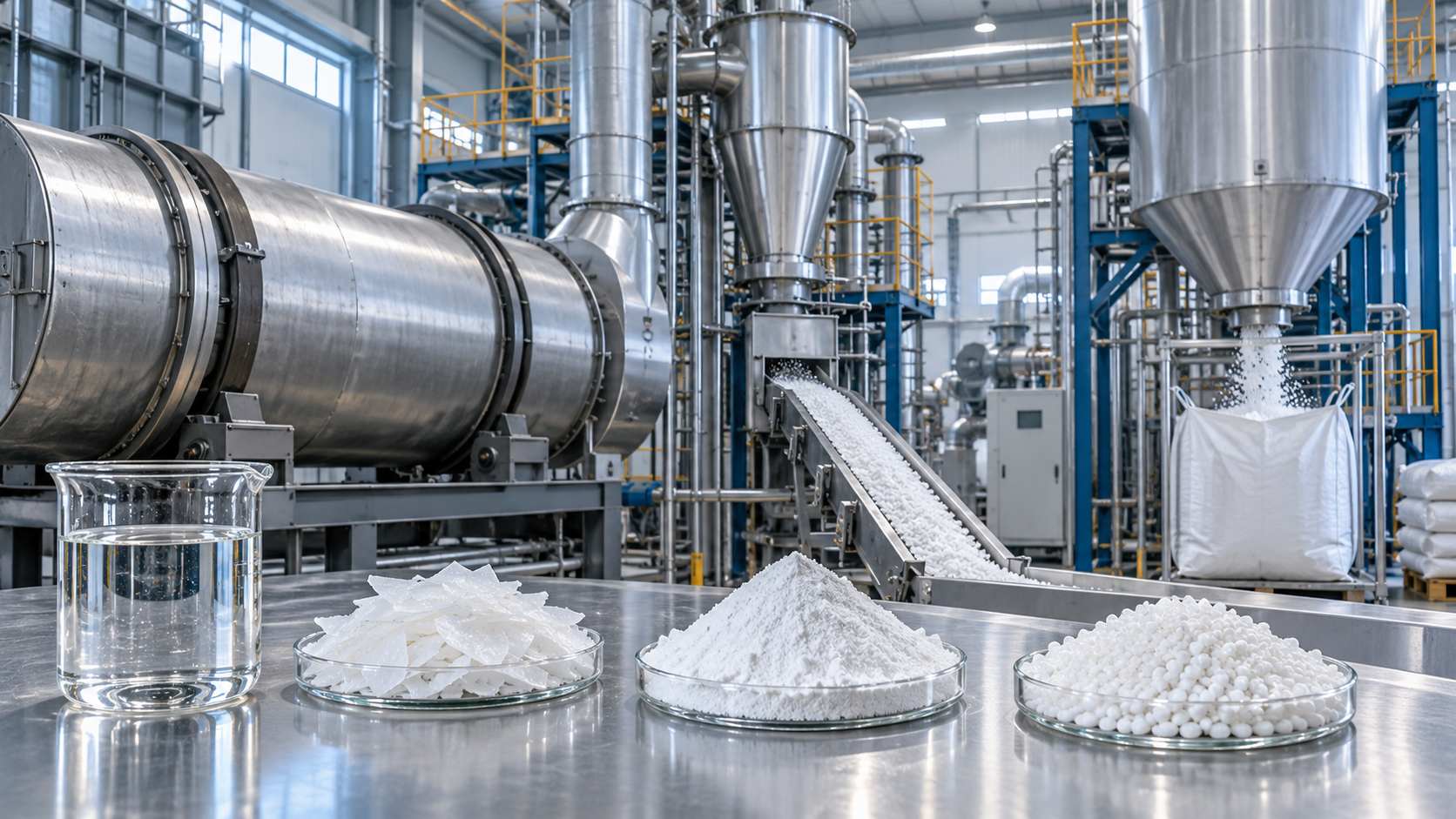
Drying determines whether a calcium chloride production line delivers liquid, flakes, powder, or granules with consistent moisture and handling properties. The drying method must match solution concentration, impurity profile, product grade, capacity, and the intended package. A linea di produzione di cloruro di calcio should connect upstream purification with the final drying and cooling conditions.
Why Product Form Changes the Drying Duty
Liquid calcium chloride needs concentration control and storage stability. Flakes require a surface that supports evaporation and release. Granules require atomization, fluidization, seed movement, and controlled cooling. The same feed solution can therefore need different equipment and operating limits for different products.
| Product form | Main drying concern | Key control |
| liquido | Concentration and crystallization | Density, temperature, and tank residence |
| Flakes | Film thickness and release | Drum surface, feed rate, and cooling |
| Powder | Fine-particle carryover | Atomization and gas cleaning |
| Granules | Size distribution and strength | Seed rate, spray rate, and fluidization |
Product specifications should define moisture, assay, particle size, fines, caking tendency, and packaging condition. These limits determine the final dryer and cooler design.
Solution Preparation Before Drying
Drying cannot correct every upstream problem. Suspended solids can foul nozzles or form dark inclusions. Excess free acidity can change corrosion conditions. Variable concentration changes viscosity and atomization. Clarification, filtration, and a purified-solution buffer improve dryer stability.
Feed tanks need reliable level, temperature, density, and mixing measurement. A buffer can separate a short pretreatment disturbance from the dryer, but its residence time should not allow unwanted settling or crystallization.
Spray Fluidized-Bed Granulation
Granulation uses hot gas to remove water while sprayed solution wets moving seed particles. Atomization, inlet temperature, outlet temperature, air velocity, spray rate, and seed circulation determine whether particles grow evenly or become sticky.
High spray rate can create agglomerates and wet discharge. Excessive gas temperature may create surface crusting or product discoloration. The operating window should be established with representative solution concentration and impurity data rather than a water-only trial.
Flake and Powder Drying Considerations
Flake equipment requires stable film formation and controlled release from the heated surface. Feed distribution, surface temperature, scraper condition, and cooling affect thickness and breakage. Powder systems need careful atomization and dust collection because fine particles can increase carryover and cleaning demand.
Exhaust treatment belongs in the design basis. Hot, humid air may carry acidic mist or fine calcium chloride. Duct velocity, demister selection, fan capacity, wash liquid, and access for cleaning affect both compliance and uptime.
Moisture, Cooling, and Packaging
Final moisture depends on dryer duty and cooling. A product packed while still warm can condense moisture inside the bag or form bridges in storage. Cooling should bring product to a packaging-compatible temperature without exposing hygroscopic calcium chloride to humid air for too long.
Sampling should cover dryer discharge, cooler discharge, and packaged product. Record moisture, assay, particle-size distribution, bulk density, and visual condition by production period. A single final sample cannot explain a change caused by spray rate, inlet temperature, or solution concentration.
Supplier Data and Project Scope
Provide target product form, assay, moisture, particle-size range, solution concentration, impurity limits, capacity, utilities, fuel, exhaust requirements, and packaging method. Buyers can review calcium chloride equipment e send the project data through the contact page.
Comparing Drying Performance in Daily Operation
Dryer selection should be tested against the operating range, not only a laboratory sample. Track feed concentration, viscosity, inlet and outlet air temperature, exhaust humidity, product temperature, residence time, and final moisture. The same dryer can produce different results when solution solids, impurity level, or ambient humidity changes.
A production record should connect each batch to nozzle condition, filter status, air-flow setting, spray rate, and cooling performance. This makes it possible to separate a feed-preparation issue from a dryer-control issue. It also gives the supplier useful evidence when a product-form change appears after maintenance.
Dust, Fouling, and Emission Control
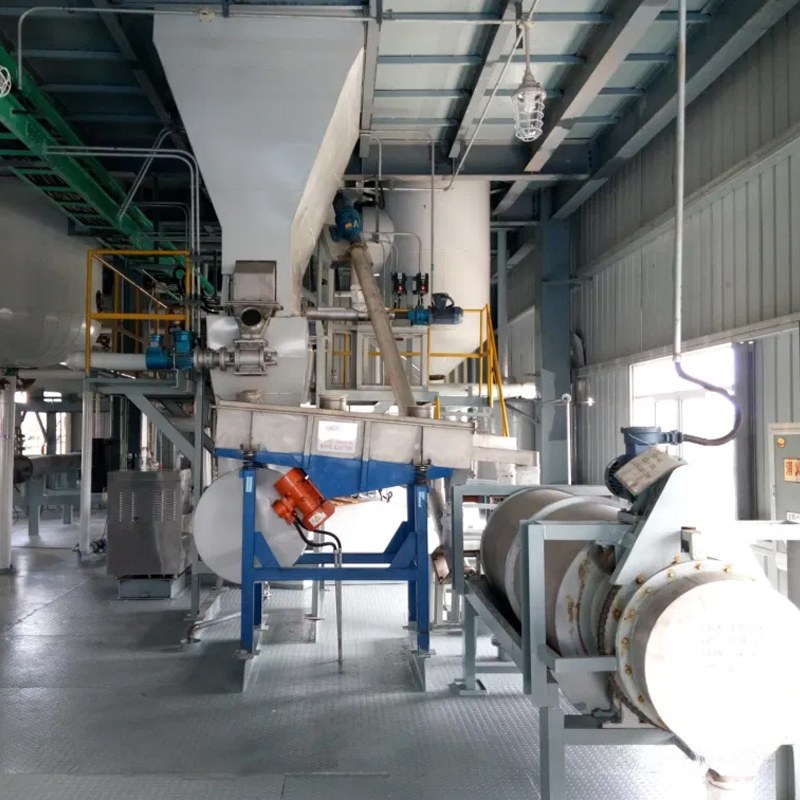
Fine calcium chloride is hygroscopic and can collect on ducts, demisters, and filters when exhaust conditions are poorly controlled. Sticky deposits reduce effective area and may change fan load. Cleaning access, wash-water drainage, corrosion-resistant materials, and a defined waste route should be included in the equipment layout.
Emission control should be sized for start-up, normal operation, and upset conditions. A system that works only at the average flow may struggle when spray rate or moisture rises. Monitoring fan pressure, demister differential pressure, scrubber circulation, and outlet condition gives operators early warning.
Product Handling After Drying
Cooling, screening, and packaging are part of product quality. Granules that leave the dryer at different temperatures can develop different moisture profiles in storage. Screens should separate oversize and fines without excessive breakage. Conveyors and hoppers should limit dead zones where hygroscopic material can cake.
Packaging film, bag sealing, warehouse humidity, and pallet protection influence shelf life. A well-controlled dryer cannot compensate for moisture entering after packaging. The product specification should therefore state sampling points both before and after packing.
Selecting a Route for the Target Market
The choice between liquid, flake, powder, and granule should reflect customer handling, transport, dosing, and storage requirements. Liquid product may reduce drying demand but needs suitable tanks and corrosion control. Flakes can be convenient for manual addition, while granules may reduce dust and improve metering. Each route changes equipment footprint, utilities, and maintenance.
Heat and Mass Balance for the Dryer
The dryer balance should begin with solution flow and concentration. Water entering with the feed must leave mainly through exhaust gas, while a smaller amount remains in the product or cleaning streams. Ambient-air humidity changes the drying capacity, so summer and winter cases may produce different outlet conditions at the same inlet temperature.
Fuel type and heating method affect control response and product exposure. Direct heating requires clean combustion and stable air ratio. Indirect heating separates combustion gas from the product air but adds exchanger duty and pressure loss. The choice should reflect product specification, local fuel, emissions rules, and maintenance practice.
Start-Up, Shutdown, and Product Changeover
During start-up, the bed or drying chamber needs a stable thermal condition before full solution feed begins. Introducing liquid too early can create wet deposits, nozzle buildup, or agglomerates. Shutdown should reduce solution feed first, dry the remaining material, and leave the equipment in a condition suitable for cleaning or restart.
A plant that makes more than one product form needs a changeover plan. Residual fines, concentrated liquor, or screen fractions from one grade may affect the next grade. The plan should state which material can be recycled, which must be segregated, and how the equipment is verified clean.
Questions for Dryer and Granulator Selection
- What feed concentration and viscosity range can the system accept?
- What product moisture and particle-size limits are guaranteed?
- How are fines returned without creating uncontrolled buildup?
- What exhaust cleaning and wash-water systems are included?
- What cleaning access and spare atomization parts are provided?
These questions should be answered together with power, fuel, air, cooling-water, and compressed-air consumption. Utility figures need defined inlet conditions and operating cases. A low nominal heat requirement is not meaningful if it excludes start-up, exhaust treatment, or product cooling.
Product testing should use agreed methods. Moisture results can vary with sample exposure because calcium chloride absorbs water rapidly. Samples need sealed containers, defined cooling time, and prompt testing. Particle-size results also depend on sieve method and handling. Writing these details into the acceptance procedure prevents disputes during commissioning.
Hebei Aoliande Chemical Equipment Co., LTD. supplies calcium chloride production line solutions covering calcium-liquid preparation, drying, granulation, and related engineering support. The agreed scope should state product guarantees, utilities, installation guidance, commissioning, and emissions responsibilities.
Conclusione
Calcium chloride drying method affects more than water removal. It controls product form, moisture, particle size, caking, dust, energy demand, and packaging behavior. A stable result comes from matching feed preparation, dryer type, exhaust treatment, cooling, and sampling to the final product specification.
Domande frequenti
Which drying method is suitable for calcium chloride granules?
Spray fluidized-bed granulation is one option when solution concentration, seed behavior, air conditions, and target size are defined.
Why must purification be stable before drying?
Solids, acidity, and concentration variation can foul atomizers, change viscosity, and create inconsistent product.
How is calcium chloride moisture controlled?
Control solution concentration, drying temperature, residence time, exhaust conditions, cooling, and packaging exposure.
What information should a supplier receive?
Product form, assay, moisture, particle size, capacity, feed solution, impurities, utilities, fuel, exhaust, and packaging data.