
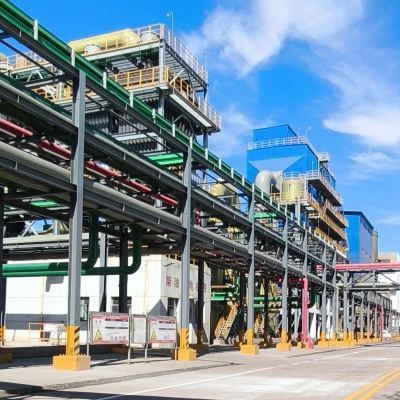
ALT: Single vs Double Contact Absorption for Sulfuric Acid Production
Two sulfuric acid plant offers can name the same capacity and answer different questions. One may promise a conversion percentage at the converter outlet; the other may specify sulfur dioxide at the stack. Neither figure tells an owner whether the plant will meet its permit through a summer cooling-water peak or a low-load shift. That uncertainty is where the choice between single and double contact absorption begins.
For the bid review, one shared set of assumptions is more valuable than a page of equipment names. Put the feed, output and stack test on that page first. The tower arrangement can then be judged against a real constraint.
Where the Gas Goes
The contact process has three relevant gas-side jobs: dry the incoming stream, oxidize sulfur dioxide over catalyst, and absorb the resulting sulfur trioxide into acid. A single contact arrangement completes its converter sequence before the main absorption step. Double contact places an absorber between earlier and later catalyst beds and then uses final absorption after the later beds.
Why interrupt the converter? Once the intermediate absorber takes out sulfur trioxide, the remaining gas can undergo more conversion in the last beds. The location of that absorber is therefore the point of the design. It has to be supported by suitable gas temperature, acid strength and flow; otherwise a second tower alone buys little.
The Permit Comes Before the Flow Sheet
An emission limit may be expressed as concentration, mass per unit of acid, or more than one measure. The sampling position and averaging period matter just as much. A number from the converter cannot be treated as though it were a stack test. The permit may apply to a two-hour average while a bid highlights a favorable steady-state minute. Put the averaging rule beside the quoted figure.
A simple mass balance makes conversion figures less deceptive:
| Inlet SO2 | Conversion | SO2 left before other controls |
|---|---|---|
| 100 mass units | 98% | 2.0 mass units |
| 100 mass units | 99.7% | 0.3 mass units |
The second outlet is 85% lower than the first in this deliberately simplified example. This arithmetic does not predict a particular plant’s stack result, which also depends on its gas balance and any downstream controls.
Some technical report give historical ranges of roughly 95–98% conversion for many single-absorption plants and 99.7% or more as achievable with dual absorption. Those are context for evaluating a proposal, not design guarantees or today’s permit limits. The plant-specific guarantee still needs feed quality, load, acid conditions and an agreed test protocol.
When Single Contact Is a Sound Option
A shorter gas path can be useful where the permit allows sufficient margin. The saving is not just steel: fewer acid circuits mean fewer seals, instruments and demisters to inspect. The proposal must still account for drying, fan capacity and mist control. If an exhaust scrubber is needed, its operating cost belongs in the single contact total.
At turndown, a converter is not simply a smaller version of its full-load self. One outlet reading can mask a cooler bed earlier in the train. Request a temperature profile for the minimum stable load, with the same attention to draft and fan pressure drop that the full-load case receives.
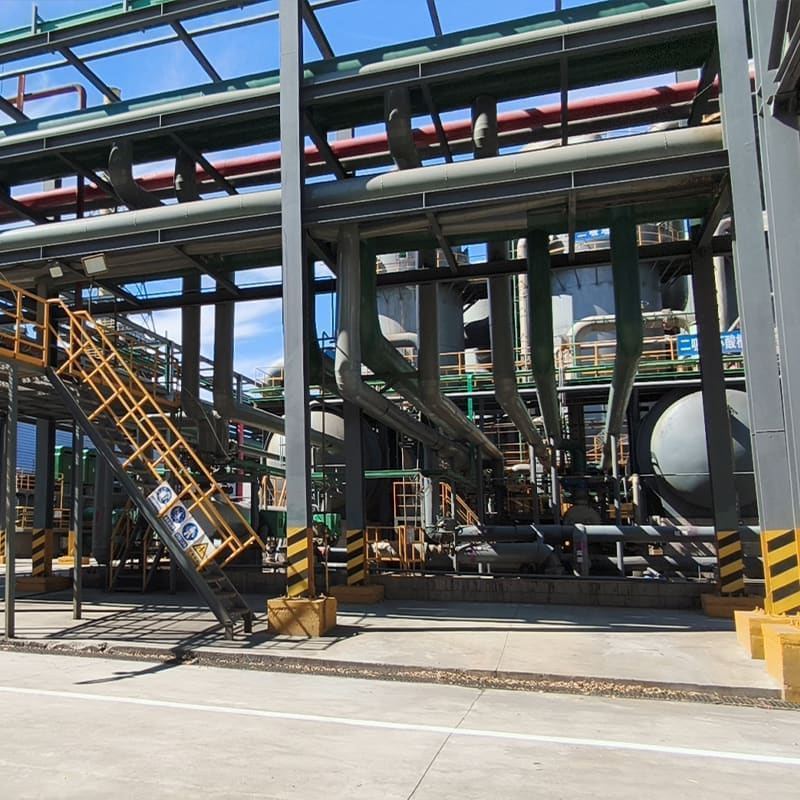
ALT: Sulfuric Acid Process Line Equipment
What Double Contact Requires Operators to Watch
An intermediate absorber creates another acid loop. Its circulating acid must remain at the required strength and temperature while gas flow changes. If cooling water weakens in summer, the loop may lose margin just when full-load performance is needed. These are operating duties, not only extra entries on an equipment list.
An equipment review can start with four questions:
1. If the intermediate acid pump stops, which valve moves and what happens to the gas entering later catalyst beds?
2. Which acid concentration measurement will warn of dilution?
3. How is a blocked demister identified before pressure drop limits output?
4. During start-up, when may gas enter the later catalyst beds?
The answers should appear in the cause-and-effect schedule and start-up instructions. A trip response that exists only as an operator assumption is not a design feature.
Equal-Basis Comparison
| Decision item | Same basis required from both offers | Reason it matters |
|---|---|---|
| Sulfur feed | Purity, moisture, ash and variation | Changes gas quality and cleaning duty |
| Production | Acid concentration and net output | Prevents comparison of unlike capacity figures |
| Converter | Bed temperatures, catalyst inventory and pressure drop | Exposes limits at full and reduced load |
| Absorption | Acid strength, flow and cooling-water conditions | Shows whether the gas route can hold its design point |
| Emissions | Stack location, averaging period and method | Connects a guarantee to the permit |
| Utilities | Fan power, pumps, steam and start-up demand | Captures the cost of the full operating line |
The table is most useful when a supplier fills it with numbers and design boundaries. “Normal conditions” is not a boundary. A low capital price can look different once cooling, treatment or instrument spares omitted from a bid are added back.
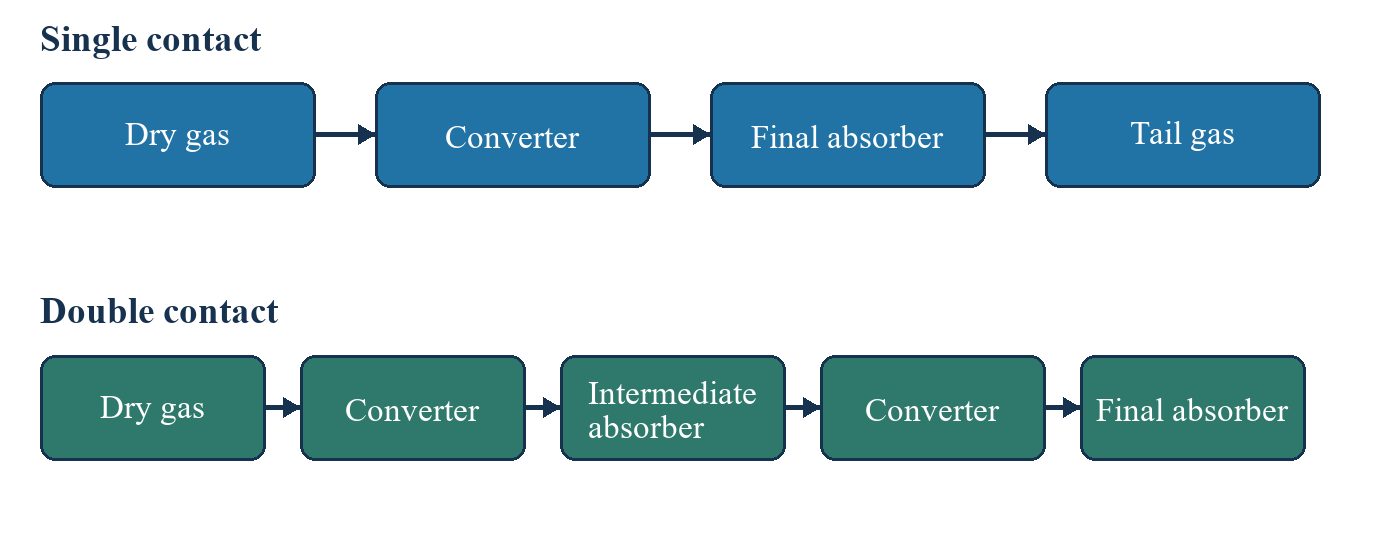
ALT: Single and Double Contact Gas Paths
Maintenance Is a Route-Level Question
Counting pieces of equipment is a poor proxy for availability. A critical fan can stop either design. Double contact adds pumps and instruments, yet access and isolation can make a planned intervention shorter. Request maintenance access around demisters, catalyst loading points, exchangers and pump seals. Ask which spares have long delivery times.
An analyzer also needs a credible sample system. A blocked sample line can produce a misleading reading long before the converter itself has changed. Pair automated monitoring with calibration, sample conditioning and an independent verification method. The arrangement should be accessible while the plant is operating safely.
Before the Route Is Fixed
Hebei Aoliande Chemical Equipment Co., LTD. can scope a sulfuric acid line around the selected feed, local utilities and emissions basis. Send an actual sulfur assay and the permit test method with the inquiry; a capacity figure alone leaves too much open to interpretation. The proposal should then identify guaranteed conditions, supply boundaries, commissioning responsibilities and what the owner must measure during acceptance.
Conclusione
Single contact is a credible choice when its stack-emission margin survives the site’s feed and load variation. Double contact offers additional conversion through intermediate absorption, with another acid circuit to operate. The decision rests on the same feed, load and stack-test basis for both schemes. For a project review, send the sulfur assay and permit basis through the project contact page.
Domande frequenti
The following answers clarify the limits of the comparison.
Does double contact always make a plant compliant?
No. Check the guaranteed stack result at the agreed feed and load conditions; the name of the flow sheet is not a permit test.
Is a conversion percentage enough to compare offers?
No. Request a stack-emission basis and a common feed, load and measurement method. Small conversion differences can represent much larger differences in the unconverted fraction.
Can a single contact plant use tail-gas treatment?
Yes. Where it is required, include that system and its utilities in the full process and cost comparison.
What changes at minimum stable load?
Bed temperatures, draft, acid circulation and the emissions result may differ from the rated-output case. Ask for both operating points in the guarantee.
How should the emissions guarantee be tested?
Specify the stack sampling point, averaging period, feed and load conditions, acid strength and utility assumptions before the acceptance run.