
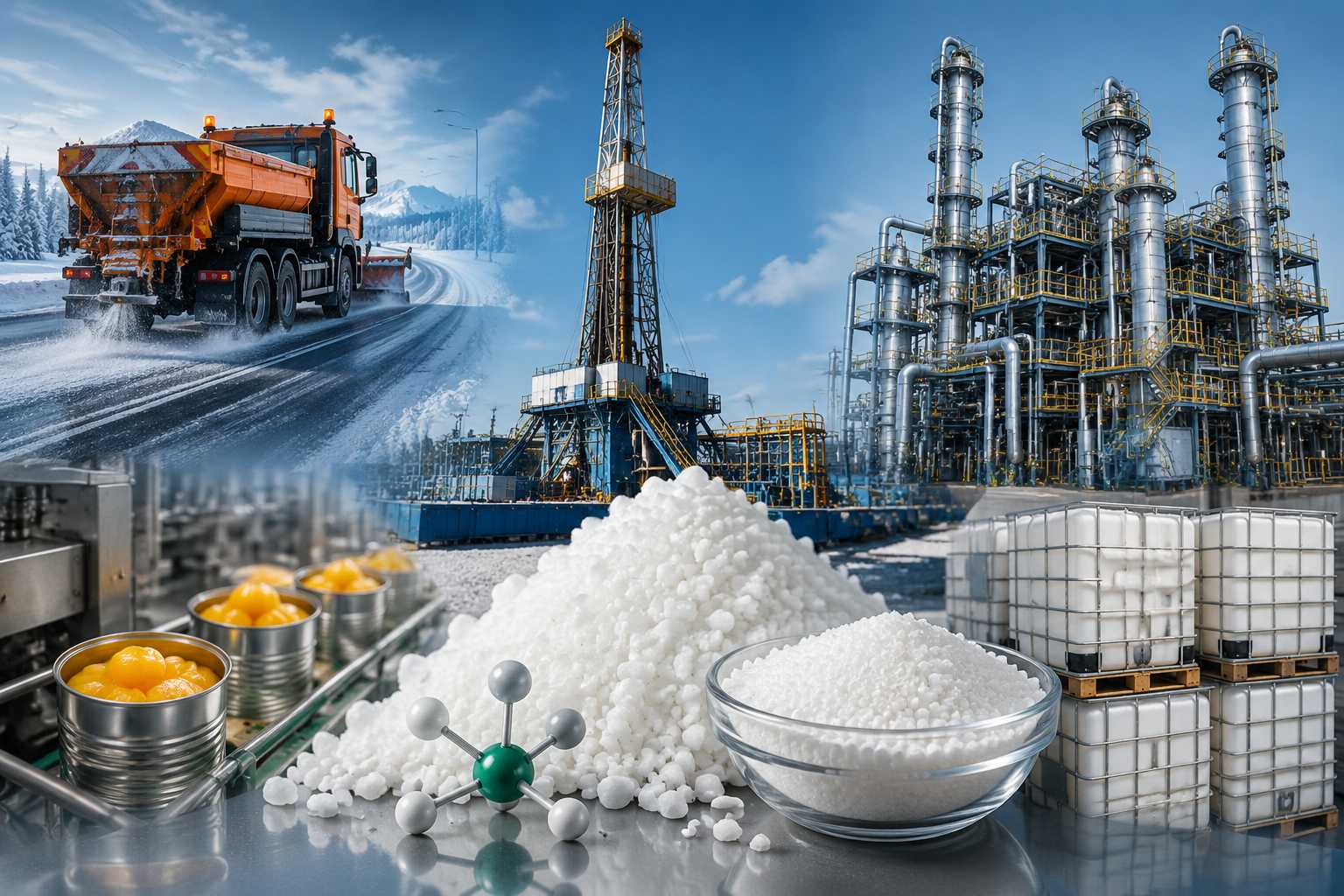
Calcium chloride is an industrial chemical which is well known on the market and is even growing. The substance is very efficient, as it lowers the freezing point of water and absorbs moisture from the air. Furthermore, it easily dissolves in water. As an industrial chemical, calcium chloride is offered by suppliers as a liquid as well as in the form of flakes, granules or as an anhydrous product. Depending on the area of application, the corresponding form is chosen.
A recent market size estimate for the global market for calcium chloride was provided and came in at USD 2.23 billion in 2026. The forecast for 2034 for the same global market was provided as approximately USD 3.53 billion. While it is important to note individual forecasts, there are many different demand categories that are using calcium chloride for many different reasons, including transportation, energy, construction, food processing, dust control and chemical manufacturing. Each of these categories of demand are expected to remain at or near steady levels even as individual categories of demand are growing or declining.
What Is Driving Global Calcium Chloride Demand?
The major drivers for growth change by season and region. While the spike in demand for winter road work is sudden, other uses such as oilfield, food service, construction and industrial provide a more constant level of demand throughout the year. Therefore, in total, a broad and stable market is supported.
Deicing and Winter Road Maintenance
One of the largest and most visible uses of calcium chloride is for road maintenance. Calcium chloride can be mixed with water to form a low-freezing brine which can be used on roads at temperatures where ordinary sodium chloride would not work. From Federal Highway Administration data, the eutectic point of a solution of calcium chloride and water is approximately -51°C (-60°F) at a concentration of about 30% by weight of calcium chloride.
These values for road use depend on several factors, such as the pavement temperature, the concentration, traffic, precipitation and the application quantity. The commercial value of this product is based on fast brine formation and low-temperature action. This product is used for anti-icing, deicing, pre-wetting of salt and other hazardous road areas such as bridges, ramps, parking lots and airport surfaces.
A severe winter brings a short buying window for regional demand for calcium chloride. Typically, buyers will stock up in advance of a severe winter in order to be able to respond when storms do develop.
Oil and Gas Drilling and Completion Fluids
Calcium chloride brines are used in a variety of drilling, completion and workover fluids. In addition to imparting density to a brine, these fluids limit the hydration of clays and the resulting swelling of shales, conditions that cause problems in wells and must be controlled to achieve stable well conditions.
This is a consistent, high value market where oilfield buyers are buying materials to meet certain fluid-density targets, as well as contamination limits, and handling constraints. Therefore, the purity of the product and the process control become commercial issues rather than just lab specifications. Suppliers of consistent quality are able to develop long term relationships with oilfield buyers.
Calcium Chloride Applications Go Far Beyond Winter Use
The volume of deicing for the seasonal market is very large, but the industrial uses of the calcium chloride for the year-round market are of a far greater demand. Uses and factors are given in the following table.
| Application | Função Principal | Demand Driver |
|---|---|---|
| Road maintenance | Deicing, anti-icing, pre-wetting | Winter safety |
| Oil and gas | Drilling and completion brines | Well activity |
| Construção | Set acceleration in suitable mixes | Faster project cycles |
| Dust control | Moisture retention on unpaved roads | Mining and road maintenance |
| Food processing | Firming and processing functions | Food and beverage output |
| Indústria química | Drying and process uses | Industrial production |
Since all applications do not go up and down at the same time, a spread supports a more balanced market through the various economic cycles.
Construção e Infraestrutura
Calcium chloride is a set accelerator for concrete. As early development of strength is stimulated, it is suitable for use in cold weather, precast concrete production, repair work and for other applications where formwork needs to be moved quickly. Contractors are keen to make best use of their time when working under pressure.
Not every mix is suitable for every application. While structures made with reinforced or prestressed concrete may have to observe a chloride limit in order to prevent steel corrosion, the construction demand will largely depend on the specific application, the project requirements and the mix design. It is not a direct function of the total volume of construction. The correct product must be specified for the job at hand.
Dust Suppression on Unpaved Roads
Calcium chloride is a hygroscopic product. It will attract and hold moisture. As a dust suppressant on mine haul roads, quarry roads, construction access routes and other unpaved surfaces fine particles will not become airborne allowing for good visibility and reduced dust-related problems.
Buying decisions are operational. Heavy dust on roads can lead to reduced visibility, to more frequent water-truck runs, to material loss and damage to neighboring equipment. Calcium chloride is a road-maintenance cost that is compared with the cost of extra water used, with wear on equipment and with lost production. Over the long term, in many cases, the chemical is the more practical solution.
Food Processing and Other Industrial Uses
Calcium Chloride is used as a firming agent, anti-caking agent, pH-control agent, drying agent, and processing aid in various applications, including cheese, canned fruits and vegetables, beverages and other processes requiring control of food products. Note that this market requires the correct food-grade specification versus industrial grade materials, and adheres to strict quality and purity standards.
Calcium chloride is used in refrigeration brines, drying, in chemical processing, in paper production, and in other industrial applications. Even though these are small applications, they do add up, and they help to reduce our dependence on any single end market, as well as smoothing out the seasonality of our business.
Regional Demand Follows Different Patterns
The growth of the global calcium chloride market can be explained by different factors in different markets and countries. In North America the winter demand for road deicing is combined with the demand from the oilfield and other industries. In Europe there is a mature market for deicing as well as for water treatment and processing. The growth of the Asia Pacific market is linked to the increasing demand for calcium chloride from infrastructure, from urbanization and from industrial production which is increasing fast. Each market has its own time frame and volume development.
For producers, understanding these production patterns helps with plant design. A deicing supplier will typically build inventory just before winter, whereas the producer of products for the oilfield, food or chemical industries will typically need tighter consistency and may have to package in different ways in order to serve a number of different product grades throughout the year. They must design their capacity to meet the needs of their regional customers.
It makes sense to select a market before selecting the necessary equipment for a manufacturing plant for calcium chloride. The following factors affect the economy of a manufacturing plant for calcium chloride: product form, required purity, annual capacity, required raw-materials, energy prices, required packaging and local emissions.
Manufacturing Capacity Is Part of the Market Story

Growing demand for materials is not of much value unless they can be supplied on a regular basis. Therefore, in the manufacturing of calcium chloride, there must be a reliable supply of raw materials, effective concentration and drying, corrosion control, emission control and the end product must be of consistent quality. All of these factors must function effectively in order to maintain an efficient plant.
From Raw Materials to Finished Calcium Chloride
A typical process for the production of calcium chloride first reacts limestone with hydrochloric acid to form a solution of calcium chloride. After purification and concentration of the solution, the material can be dried or granulated, as required, to produce a solid product.
A complete calcium chloride production line may include:
- raw-material storage and feeding;
- reaction and calcium chloride liquid preparation;
- purification and concentration;
- drying or granulation;
- exhaust-gas and dust treatment;
- conveying and packaging;
- piping, controls, instruments, valves, and utilities.
Spray fluidized-bed drying is used for the production of anhydrous calcium chloride granules. In this process the increased contact between hot gas and material promotes the heat transfer and the formation of particles. In addition to the energy consumption, product purity, particle size, corrosion protection, maintenance access, flexibility of operation and emissions treatment have to be compared for different plants.
Why Production Flexibility Matters
The feed conditions are never the same from day to day. The hydrochloric acid concentration, the moisture content, etc. can vary. In addition, the customer may require different forms of output. A stable process must have enough flexibility to handle the normal variation and not produce off-spec product or have to shut down frequently. The flexibility will then also safeguard the quality and the uptime.
This is why calcium chloride production equipment should be evaluated as one process. A high-capacity dryer has limited value if reaction, concentration, gas treatment, or packaging becomes the bottleneck. Balanced design across the whole line supports reliable daily operation.
Hebei Aoliande as a Calcium Chloride Production Line Supplier
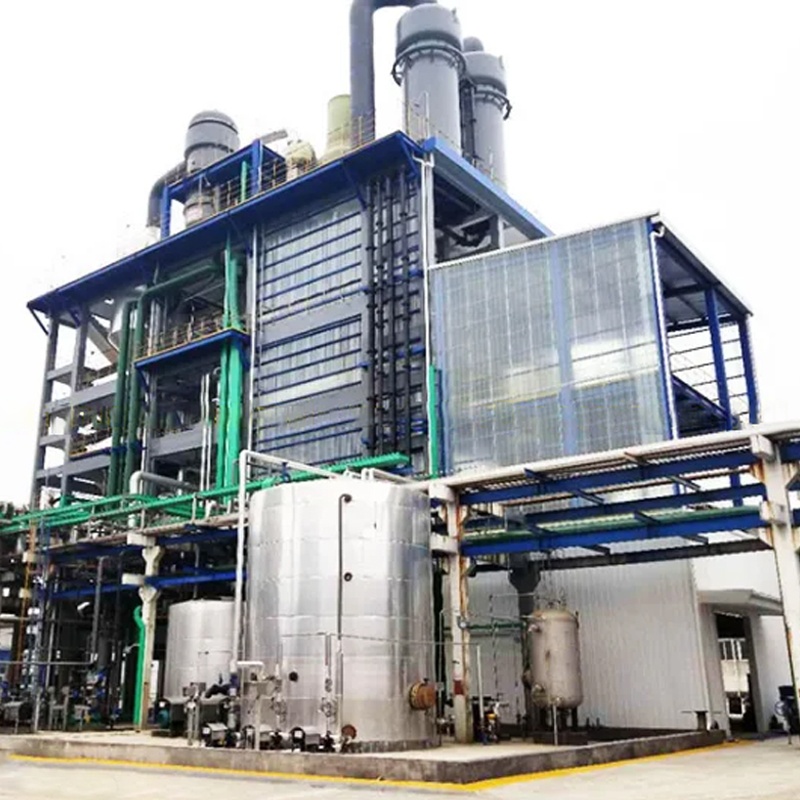
Hebei Aoliande Chemical Equipment Co., LTD. Specializes in Designing and Manufacturing of Calcium Chloride Production Lines as well as Other Types of Chemical Plant Equipment. Our Calcium Chloride Plant Projects scope of supply can include Liquid Calcium Chloride Production, Drying and Granulation sections, as well as Piping, Electrical, Instrumentation, Valves and Utilities design. We offer integrated and practical solutions.
By combining a manufacturer of equipment for industrial plants with engineers who are able to provide the best technical solutions, Aoliande provide support with material, transportation and installation. The Calcium Chloride Process using Hydrochloric Acid and Limestone can also use Hydrochloric Acid from other industrial sources. A project owner comparing suppliers for a Calcium Chloride Plant will want an integrated process and equipment offer to minimize the normal interface problems between engineering and the procurement of equipment and for installation. Such clear communication between the design team and the fabrication teams ensures that the project completes on time.
Conclusão
Global demand for calcium chloride, which can serve a number of durable end uses, continues to increase. Winter road use, oilfield and other industrial fluids, dust control, and other construction applications, as well as use as a feedstock in food processing and a number of other industrial chemicals, represent a number of somewhat disparate markets that do not increase and decrease at the same time. This diversity creates a larger, more stable demand base for the industry.
For producers, market growth is only the starting point. Strong projects are based on local feedstock and energy, a defined target market, suitable product, reliable CaCl2-production technology and a production line from reaction to packaging.
FAQ
Why Is Calcium Chloride Demand Increasing Globally?
Deicing, road maintenance, oil and gas fluids, dust suppression, food processing, construction and chemical manufacturing all contribute to demand. The infrastructure and industrial activity generated in seasons outside of winter also contribute to consumption. End uses are diverse, thus helping to keep total volume relatively stable from year to year.
What Are the Main Industrial Applications of Calcium Chloride?
Deicing and anti-icing are major applications for calcium chloride, in addition to drilling and completion brines, dust control, concrete acceleration, and other specialty applications in appropriate concrete mixes, as a refrigeration brine, drying agent, food processing aid, and chemical process agent.
How Is Calcium Chloride Produced?
A typical process to produce Calcium Chloride reacts Hydrochloric Acid with Limestone to produce a solution of Calcium Chloride which can then be purified, concentrated, dried, granulated, conveyed and packed as the final product. Control of the process at each of these stages is critical to achieve the required quality of the end product.
What Should Buyers Check When Choosing a Calcium Chloride Production Line?
Raw material, desired purity and form, production capacity, energy, drying, corrosion resistance, exhaust, automation, service, maintenance, and supplier’s engineering and installation are key factors to consider. Examining the process in its entirety will help to identify problems before they occur.
Can One Calcium Chloride Manufacturing Plant Serve Several Markets?
This would depend on whether a suitable design has been created for suitable product forms and quality targets. Deicing, oilfield, food-grade and industrial customers have different requirements for purity, particle-size, packaging, etc. and regulatory requirements. It is best to define the target markets for a proposed plant before a final design is created and the resulting equipment can be matched to real customers’ needs.