
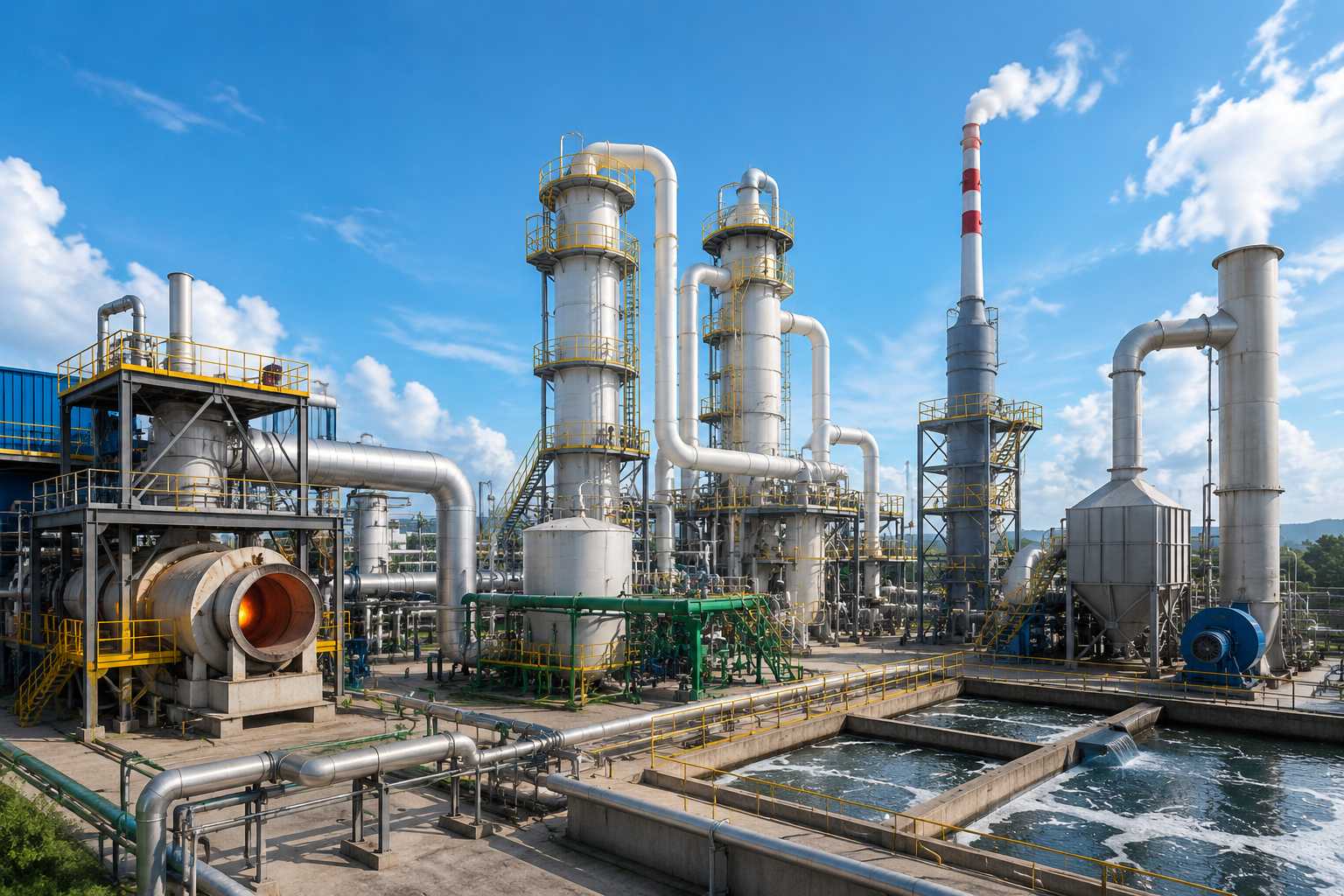
Designing HCl Absorption for a Mannheim SOP Plant
Designing HCl absorption for a Mannheim SOP plant requires a complete gas and liquid balance from the furnace outlet to the final vent. The furnace produces hydrogen chloride together with potassium sulfate, but the gas also carries moisture, acid droplets, dust, and air leakage. A Mannheim SOP production line needs an absorption train sized for these real conditions, not only the reaction equation.
Start with the Reaction and the Gas Load
The overall reaction is 2KCl + H2SO4 to K2SO4 + 2HCl. In the furnace, it proceeds through a potassium bisulfate intermediate at high temperature. The theoretical hydrogen chloride amount can be calculated from production and conversion, but the absorber sees a larger mixed-gas flow that includes water vapor, excess air, leakage air, and entrained material.
Gas load changes with furnace feed, acid ratio, conversion, seal condition, draft, and upset response. The design basis should include normal production, minimum stable load, maximum expected load, startup, shutdown, and a short upset case. An absorber sized for an average material balance may struggle when a furnace door leaks or feed control oscillates.
Every item should have a normal value and a credible range. This prevents one precise number from hiding uncertainty in feed moisture, leakage, or production rate.
Remove Solids Before They Reach the Packing
Hot furnace gas can carry potassium salts and acidic particles. If these reach an absorber, they may block distributors, coat packing, raise pressure drop, and contaminate hydrochloric acid. Gas cooling and dust removal must be coordinated with absorption because cooling can create condensate and fine droplets.
The gas path should avoid low points where acidic liquid collects without a drain. Duct velocity must keep solids moving without causing excessive erosion or pressure loss. Inspection doors need safe access and a seal suited to the local temperature and chemistry.
Where a pre-separator or wash stage is used, its liquid balance belongs in the overall acid-quality calculation. Returning dirty liquor to the product absorber may lower waste volume but raise potassium, sulfate, iron, or suspended solids in the hydrochloric acid. The intended use of the acid determines whether this is acceptable.
Use More Than One Absorption Stage When the Duty Requires It
Hydrogen chloride dissolves readily in water, and absorption releases heat. As the liquid becomes hotter and more concentrated, its ability to absorb more gas changes. Staging allows the process to manage concentration, temperature, and final gas polishing separately.
A common design logic is to contact the strongest gas with recirculating acid, cool the liquid between passes or stages, and use a weaker liquid or fresh water toward the clean-gas end. The exact flow direction and number of stages depend on product concentration, vent target, heat removal, and materials.
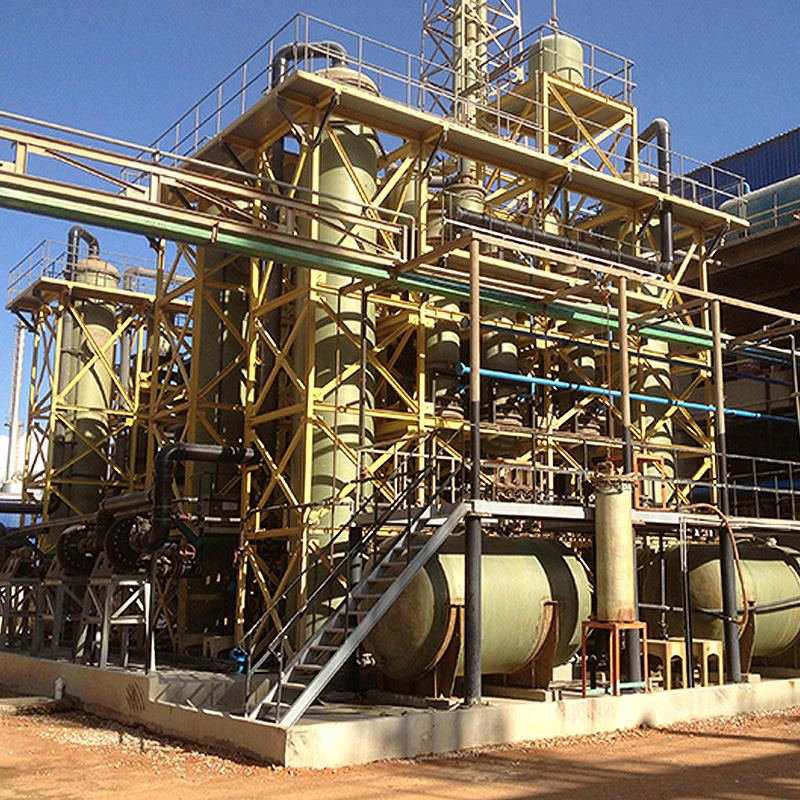
Mannheim SOP and HCl Recovery Line
Stage design should answer four practical questions:
Which stage makes saleable or reusable hydrochloric acid?
Where is fresh water added, and how is that flow measured?
How does off-spec acid return to the system without upsetting concentration?
What happens to the gas if one circulation pump or cooler is unavailable?
These questions expose control and storage needs that a tower-only quotation can miss.
Control the Heat of Absorption
Absorption heat can raise liquid temperature quickly. High temperature reduces driving force and can increase corrosion or acid vapor carryover. The cooling system must cover heat released by absorption, sensible heat in the incoming gas, pump heat, and the selected operating concentration.
Cooling-water data should include supply temperature through the hottest season, return-temperature limit, pressure, quality, and fouling tendency. A nominal water flow without seasonal temperature is incomplete. Where cooling-water quality is poor, exchanger cleaning access and spare duty may be more important than a small reduction in initial surface area.
Temperature measurement should cover absorber circulation, gas inlet, and the points needed to judge exchanger performance. A single tank temperature may respond too slowly to a local hot condition. Trend temperature with circulation flow and acid concentration so the control room can tell whether the issue is low cooling, weak circulation, or extra HCl load.
Set the Water Balance Around Product Acid
Water enters with feed moisture, dilution water, wash liquor, and possibly gas cooling. It leaves in product hydrochloric acid, vent gas, drains, and off-spec streams. The balance determines product concentration and storage volume.
Fresh-water control should be tied to measured concentration and production condition. Density provides fast feedback, but temperature correction and dissolved impurities can shift the reading. Laboratory titration should verify acid strength and create a site-specific density relationship.
An acid concentration target cannot be separated from the vent target. Pushing the product stage toward stronger acid may reduce absorption driving force and increase the duty on the polishing stage. The project should define which result has priority and how off-spec acid is handled during transitions.
Choose Materials by Zone
The system contains dry hot gas, cooling gas, concentrated hydrochloric acid, dilute acidic liquid, wet chloride gas, and external condensation. These zones do not have the same corrosion behavior. Material selection should therefore follow temperature, acid concentration, water content, contaminants, velocity, and mechanical load for each section.
Pay particular attention to duct transitions, spray nozzles, distributor supports, pump seals, exchanger surfaces, demister frames, drains, flanges, and instrument connections. A compatible tower shell does not protect an unsuitable gasket or metal fastener inside the gas path.
إن potassium sulfate equipment category can include corrosion-resistant materials and an adjusted HCl absorption system. Buyers still need material schedules that name each wetted component and state the service basis. General wording such as “acid resistant” is too broad for procurement and inspection.
Prevent Air Leakage and Unstable Draft
Air leakage increases gas volume without adding recoverable HCl. That raises tower velocity, fan duty, cooling demand, and vent flow. It can also move the operating point away from the packing and demister design.
Furnace seals, access doors, expansion joints, duct flanges, drain seals, and sample ports should be checked under operating draft. A leak test at ambient conditions may miss a joint that opens after thermal movement. Draft control should hold the furnace condition needed for reaction while keeping the absorption train within its hydraulic range.
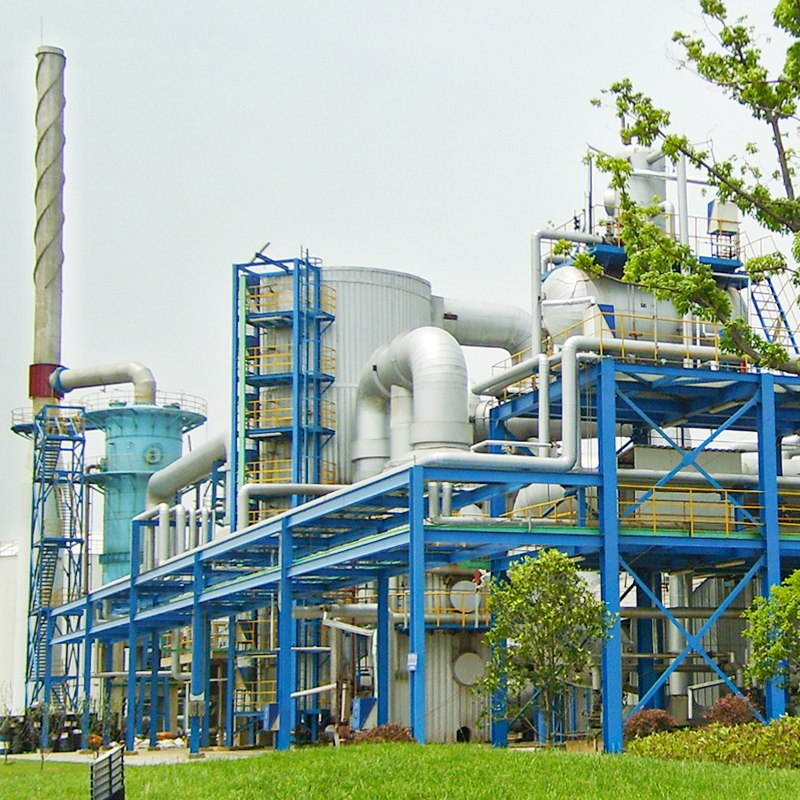
Potassium Sulfate Furnace and Absorption Equipment
Build Controls Around Measurable Conditions
The control system should help operators balance production, acid concentration, temperature, draft, and vent performance. Useful measurements include furnace draft, gas temperature, absorber pressure drop, circulation flow, tank level, acid density, cooler temperatures, fan current, and final vent indicators required by the project.
Alarms should point to a condition and response. Low circulation with continued HCl generation needs a defined furnace-feed action. High absorber temperature may require reduced load, increased cooling, or a water-balance check. The response should not depend on one operator remembering an unwritten sequence.
Commission the Train as a Connected System
Before live gas, verify vessel cleanliness, packing installation, distributor level, pump rotation, cooler flow, drain seals, valve positions, instrument calibration, fan direction, and emergency power logic. A water circulation test can reveal distribution and leaks where materials and drying requirements permit it.
During live commissioning, increase load in planned steps. At each step, record SOP production rate, feed ratio, furnace draft, gas and liquid temperatures, circulation, pressure drop, acid strength, product-acid impurities, and vent result. State the sampling method and the stable period used for acceptance.
إن project contact team should receive site utility data and product-acid requirements before the final design. Commissioning boundaries also need to name who provides laboratory testing, temporary water, neutralization, product storage, and vent sampling. Those services are often outside the equipment skid but determine whether performance can be demonstrated.
Supplier Scope and Buyer Inputs
Hebei Aoliande Chemical Equipment Co., LTD. supplies Mannheim process potassium or sodium sulfate production lines and related hydrochloric acid recovery equipment. Published company information also refers to operating experience at its potassium fertilizer facility in Inner Mongolia. Project guarantees, test methods, and battery limits should be written for the specific contract.
Buyers comparing chemical production equipment should issue a data sheet covering product rate, KCl and sulfuric acid analysis, feed moisture, expected conversion, acid concentration and purity target, vent basis, cooling water, power supply, plot limits, elevation, climate, and storage philosophy. Better input data produces a clearer absorber design and fewer changes after fabrication.
استنتاج
An HCl absorption train succeeds when gas load, solids removal, heat release, water balance, materials, draft, and controls are designed as one system. The reaction balance starts the calculation, but air leakage, moisture, impurities, and operating transitions determine real equipment duty. Stepwise commissioning then proves performance and gives operators a baseline for pressure drop, temperature, concentration, and vent behavior.
الأسئلة الشائعة
These questions summarize the main decisions made during a Mannheim HCl absorption design review.
Why is HCl absorption normally divided into stages?
Staging separates product-acid concentration control from final gas polishing and allows heat removal between contacts. It also gives the designer more control over water addition and off-spec liquid handling.
What reduces hydrochloric acid quality in a Mannheim SOP plant?
Potassium salt dust, sulfate mist, corrosion products, dirty wash liquor, unstable water addition, and poor separation can raise impurities or suspended solids. Gas cleaning and liquid routing should match the intended acid use.
Which data has the greatest effect on absorber size?
Maximum mixed-gas flow, HCl loading, inlet temperature, water vapor, target acid concentration, packing choice, allowable pressure drop, and vent requirement all matter. Air leakage can be especially important because it increases gas volume without increasing product acid.