
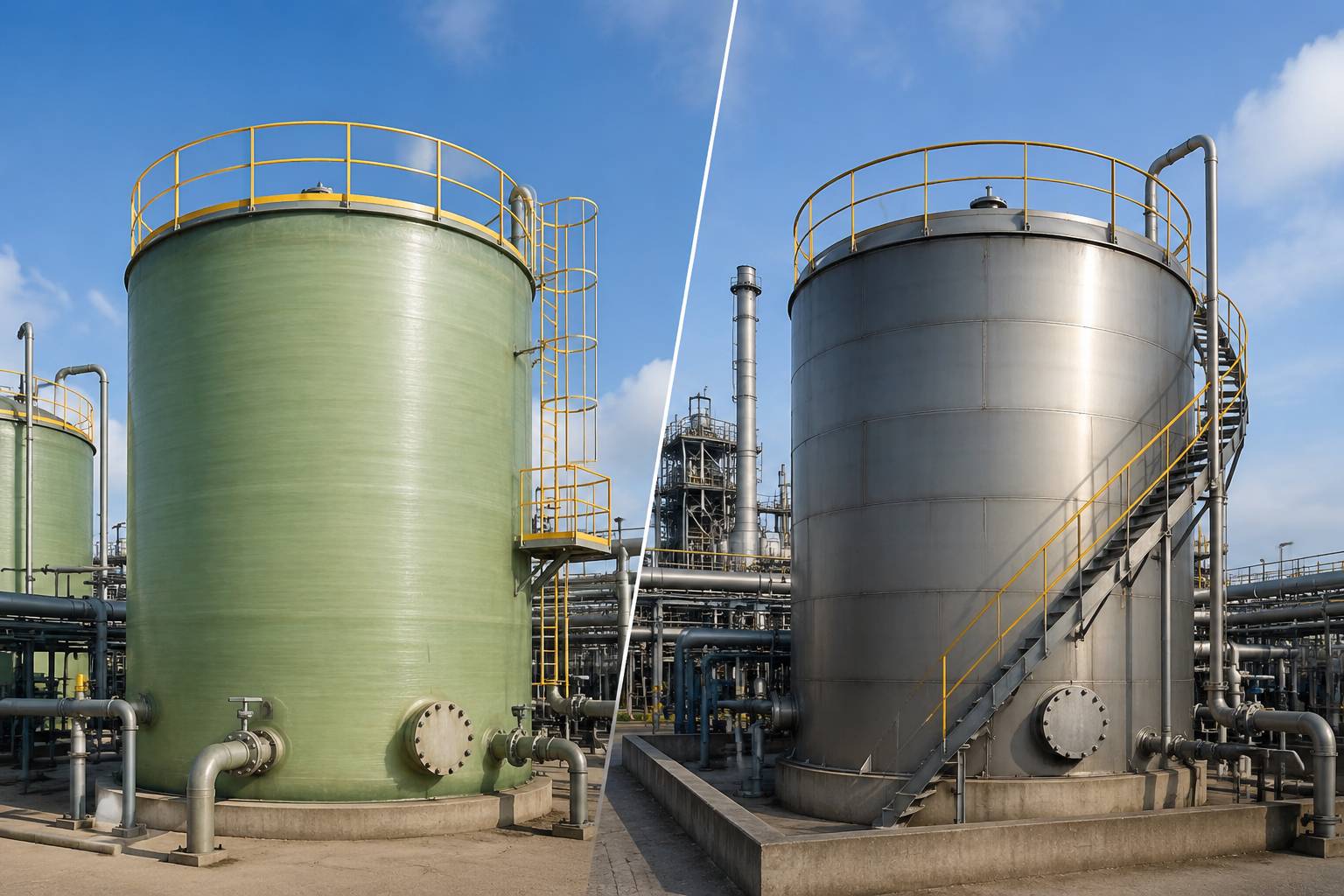
Choosing a sulfuric acid storage tank is not a simple choice between FRP and steel. At 98% concentration, the acid behaves differently from dilute grades. Temperature, moisture entry, tank size, and product purity can change the preferred material.
For many large ambient-temperature installations, carbon steel remains practical. FRP is light and corrosion-resistant in suitable service, but standard FRP should not be assumed compatible with 98% H₂SO₄. The resin, corrosion barrier, and temperature rating must match the real duty.
Why 98% Sulfuric Acid Changes Material Selection
Concentrated sulfuric acid is heavy and reactive. At about 1.84 specific gravity, it places nearly twice the load of water in the same tank. Shell thickness, foundation loading, nozzle reinforcement, wind, and seismic conditions matter alongside chemical resistance.
Concentration and Water Ingress
A common mistake is to treat every sulfuric acid concentration as the same service. Carbon steel often performs better in stable concentrated acid than in partially diluted acid. Rain through a vent, wet unloading lines, or faulty dilution can create a more aggressive local zone. Corrosion near the inlet or floor may then be far worse than the bulk concentration suggests.
FRP has a different risk. Concentrated sulfuric acid may attack some resin systems, especially at higher temperatures. “Vinyl ester FRP” is not a complete specification. Compatibility must cover the exact concentration, temperature, exposure time, and credible upset conditions.
Temperature and Process Upsets
A tank receiving cooled product acid differs from one receiving hot acid or handling dilution. Mixing sulfuric acid and water releases intense heat. A brief temperature excursion can damage a polymer barrier or speed metal corrosion. The design basis should cover startup, unloading, normal operation, and the highest credible upset temperature.
FRP vs Steel Sulfuric Acid Tanks
The main differences become clearer when chemical compatibility, structural demands, maintenance, and product purity are considered together.
| Selection factor | FRP sulfuric acid tank | Steel sulfuric acid tank |
|---|---|---|
| Chemical resistance | Strong within an approved resin range; uncertain without data for 98% acid | Often suitable for concentrated acid at controlled ambient temperature |
| Structure | Light, but laminate and nozzle design are critical | High mechanical strength; suited to large field-built tanks |
| Temperature | Limited by resin and corrosion barrier | Usually handles variation better, subject to corrosion review |
| Mantenimiento | Check for cracks, blistering, soft spots, and exposed fibers | Monitor wall thickness, welds, coatings, and corrosion |
| Product purity | Avoids iron contamination if the barrier remains intact | Iron sulfate may form unless lining or another material is used |
When FRP Is a Sound Choice
An FRP chemical storage tank can work when its resin has documented resistance to the stated concentration and temperature. Low weight and less painting are useful advantages.
For 98% sulfuric acid storage, specify the resin, corrosion-barrier thickness, laminate sequence, post-curing method, temperature limit, design life, and quality tests. Nozzle areas need close review because pipe loads or poor reinforcement can create early cracks.
FRP may suit scrubbers, ducts, selected piping, or dilute-acid service better than the main product tank.
When Carbon Steel Is the Practical Choice
Carbon steel is commonly used for bulk storage of high-strength sulfuric acid at normal temperature. It offers familiar fabrication, high strength, and economical large-capacity construction. Gradual corrosion still occurs, so the design needs corrosion allowance and an inspection plan.
The acid-to-steel reaction can produce hydrogen, requiring a reliable open vent and safe maintenance. Iron sulfate can settle, affect purity, block lines, or enter pumps. Bottom geometry, drain points, outlet elevation, and cleaning access should account for these deposits.
Is Stainless Steel Automatically Better?
No. Stainless steel is used selectively for small tanks, transfer components, or duties where iron contamination must be limited. Performance changes with concentration, temperature, velocity, and oxidation conditions. It may cost more without giving a dependable benefit unless corrosion data support the exact service.
A Practical Material Selection Method
A buyer comparing FRP and steel should define the service conditions in writing. This prevents quotations based on ideal conditions.
Data to Put in the Tank Specification
- Minimum, normal, and maximum H₂SO₄ concentration
- Normal and maximum operating temperature
- Working volume, filling rate, and delivery frequency
- Indoor or outdoor location, wind, seismic, and UV exposure
- Required acid purity and acceptable metal contamination
- Risk of dilution, water entry, or mixed chemical service
- Design code, containment, venting, and inspection needs
- Pipe loads, vacuum risk, nozzle schedule, and foundation conditions
For stable 98% acid in a large ambient tank, carbon steel often makes the shortlist. For smaller or high-purity duties, lined, polymer, or alloy options may also be reviewed. FRP should stay on the list only when the resin manufacturer and tank fabricator provide compatibility evidence for the full operating range.
The Tank Is Only One Part of the Storage System
Failures often start outside the shell. A sound sulfuric acid storage system also needs compatible gaskets, valves, bolts, vents, overflow lines, instruments, pumps, and unloading connections. Static-immersion compatibility does not guarantee success in a fast pipe, joint, or hot inlet.
The vent must stay open and resist acid mist and deposits. Secondary containment should meet local rules and remain free of rainwater. High-level alarms, overfill protection, safe drainage, and clear unloading procedures reduce release risk.
Steel tanks need wall-thickness measurements and weld checks. FRP tanks need inspection for cracks, discoloration, blistering, exposed fibers, soft areas, and nozzle damage.
Storage in a Sulfuric Acid Production Line
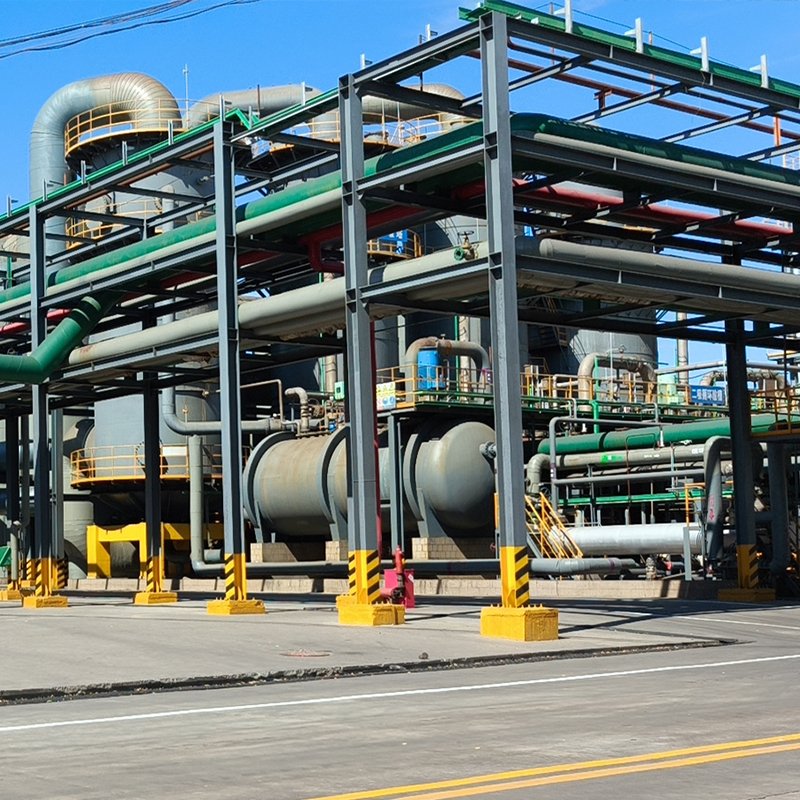
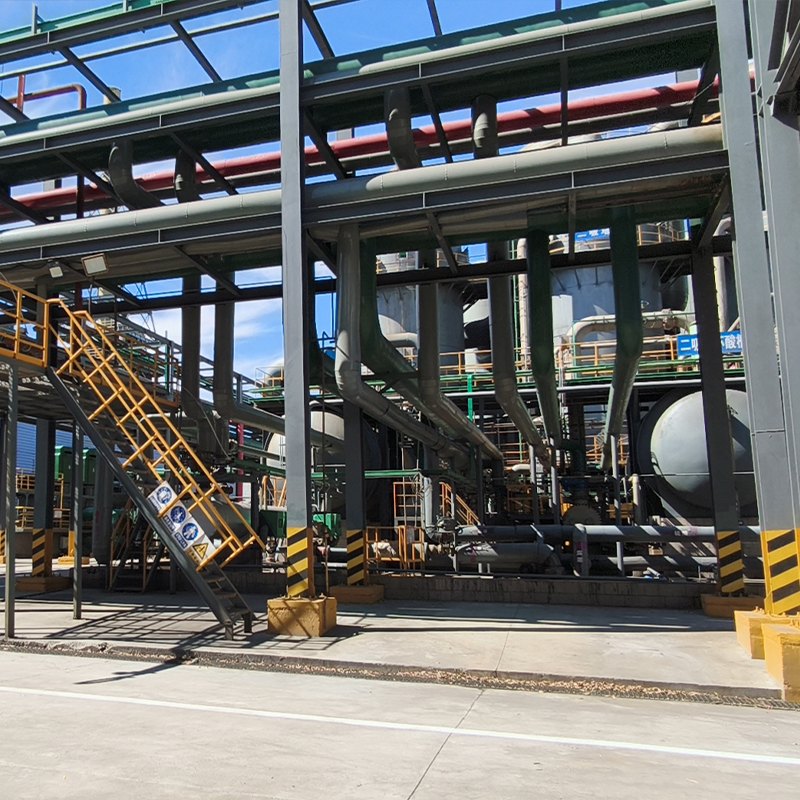
In a sulfur-burning sulfuric acid production line, storage follows sulfur melting, conversion, drying and absorption, cooling, and final handling. The tank must match the acid leaving the cooler, while pumps and piping support circulation, transfer, and loading.
A well-selected tank cannot correct unstable acid temperature, wet process air, poor venting, or badly arranged transfer lines. Equipment layout, heat recovery, acid circulation, instrumentation, and final storage work best as one process package.
Hebei Aoliande Equipo Químico Co., Ltd.
Hebei Aoliande Equipo Químico Co., Ltd. supplies sulfuric acid production lines and related chemical equipment for industrial projects. Its scope covers sulfur melting, combustion and conversion, drying and absorption, and final product handling. The company also works with FRP manufacturing equipment and other production-line systems.
This process and materials experience can help match tank selection with capacity, acid concentration, utilities, transport limits, and installation needs. A useful inquiry needs a process basis.
Conclusión
For a 98% sulfuric acid storage tank, steel is often the sound starting point for large, stable ambient storage. FRP is not ruled out by name, but it needs specific resin data and a design that covers temperature excursions, water contamination, and long-term exposure.
The final decision should rest on corrosion evidence, structural calculations, fabrication quality, inspection access, purity, and lifecycle cost. A cheap tank that is difficult to inspect, vent, clean, or repair rarely remains the lowest-cost option over the life of a sulfuric acid plant.
Preguntas frecuentes
Can an FRP tank store 98% sulfuric acid?
Only when the resin, corrosion barrier, temperature limit, and fabrication method are specifically approved for 98% sulfuric acid. Many standard FRP systems are intended for lower concentrations and should not be selected from a general chemical-resistance claim.
Is carbon steel suitable for concentrated sulfuric acid storage?
Yes, carbon steel is commonly used for concentrated sulfuric acid in ambient temperature service, especially in large tank applications. It requires corrosion allowances, venting of potential hydrogen evolution, deposits, and regular thickness monitoring.
Which is the best material to use for a sulfuric acid storage tank?
There is no single best material. The concentration, temperature, size, purity, possibility of water entry, flow rates, and maintenance capability will dictate whether carbon steel, FRP, lined carbon steel, an engineered polymer, or a corrosion-resistant alloy should be used.
Will diluted sulfuric acid attack steel more quickly?
Often it will. The presence of water may interrupt the less corrosive nature of the acid when stable at high concentrations. Wettability through unloading lines, water entry, or local dilution may produce localized corrosion areas even in a tank with stable 98% acid.