
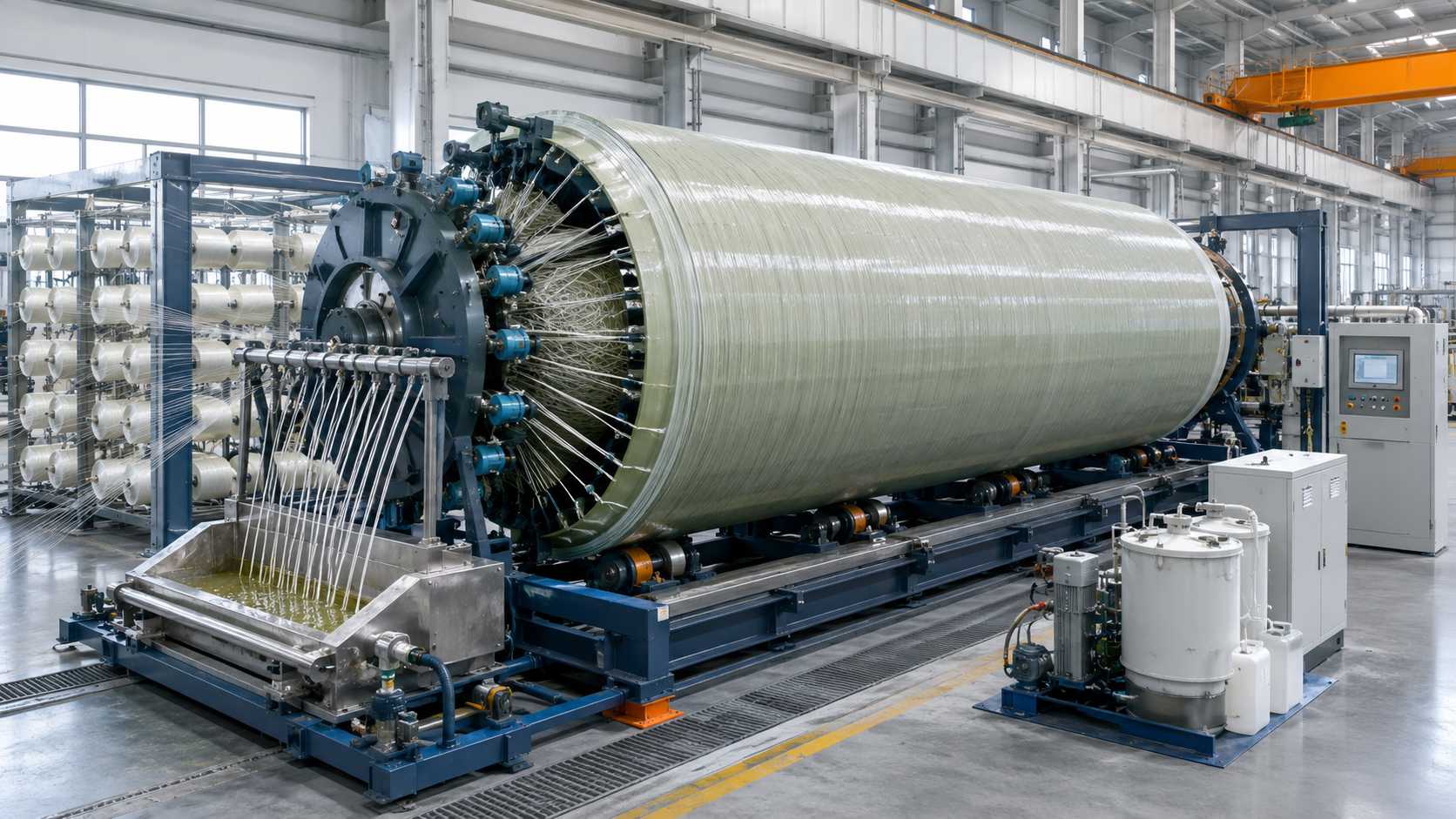
FRP chemical storage tanks are widely used in chemical plants, water treatment projects, fertilizer production, electroplating workshops, mining sites, and industrial wastewater systems. For tank manufacturers and project contractors, the real challenge is not only making a tank body. The full FRP chemical storage tank production line must produce a corrosion-resistant inner layer, a stable structural layer, accurate tank geometry, reliable fittings, and testable finished products. A clear process flow helps buyers judge whether a production line can handle daily orders, special tank sizes, chemical-duty resin systems, and repeatable quality.
What Is an FRP Chemical Storage Tank Production Line?
An FRP chemical storage tank production line is a complete manufacturing system for making fiberglass reinforced plastic tanks used for acid, alkali, salt solution, wastewater, and other industrial liquid storage. In many markets, the same products may also be called GRP tanks, fiberglass chemical tanks, composite storage tanks, or corrosion-resistant tanks.
A practical line usually includes mold preparation, inner liner forming, resin mixing, glass fiber feeding, filament winding, curing, demolding, trimming, fitting installation, and final inspection. For large tank factories, the line also needs material handling, dust control, resin storage, lifting equipment, and enough space for finished tank staging.
The process matters because each step affects field performance. A chemical tank with a good outer shape but poor resin selection, weak liner, or unstable winding angle may fail early in real use.
Why Process Flow Matters in Chemical Tank Manufacturing
Chemical storage tanks often work in tough conditions. A tank may hold hydrochloric acid in a plating plant, sodium hypochlorite in a water treatment station, or alkaline liquid in a chemical workshop. These tanks face chemical attack, temperature change, liquid pressure, outdoor exposure, and repeated filling or discharge.
A stable FRP tank manufacturing process helps control three key points:
- Chemical resistance from the inner liner and resin system
- Mechanical strength from glass fiber layout and wall thickness
- Service reliability from curing, fittings, and inspection
If the process flow is loose, common problems appear fast: dry fiber, bubbles, resin-rich areas, uneven wall thickness, weak nozzles, leakage near flanges, and surface cracks. Good equipment reduces these risks, but equipment alone is not enough. Raw materials, operator habits, workshop conditions, and inspection rules all need to match the tank’s chemical duty.
Main Equipment in an FRP Tank Production Line
Before the step-by-step flow starts, buyers need to know what equipment normally appears in the workshop. A chemical storage tank line is not a single machine. It is a group of machines and tools that work around the tank size, resin system, and production volume.
| Équipement | Fonction principale | Pourquoi ça compte |
|---|---|---|
| Tank mold or mandrel | Forms tank diameter and shell shape | Controls roundness and surface quality |
| Resin mixing system | Prepares resin, catalyst, and additives | Affects curing and corrosion resistance |
| Resin bath or impregnation unit | Soaks glass fiber rovings | Prevents dry fiber and weak layers |
| FRP tank filament winding machine | Winds glass fiber onto the rotating mold | Builds the main structural layer |
| Curing area | Allows the resin to harden | Affects strength and dimensional stability |
| Trimming and cutting tools | Process edges, openings, and ends | Supports clean assembly |
| Fitting and flange tools | Install nozzles, manholes, and outlets | Reduces leakage risk |
| Testing equipment | Checks leakage, thickness, and appearance | Confirms finished tank quality |
For medium and large chemical tanks, the FRP tank filament winding machine is the core equipment. A computer-controlled system can coordinate the main shaft and carriage, follow preset winding paths, and keep the winding angle within the required range. Machines designed for large tank production can cover tank diameters from hundreds of millimeters to several meters, long tank bodies, wide roving sheets, and high hourly output.
Step 1: Raw Material Selection
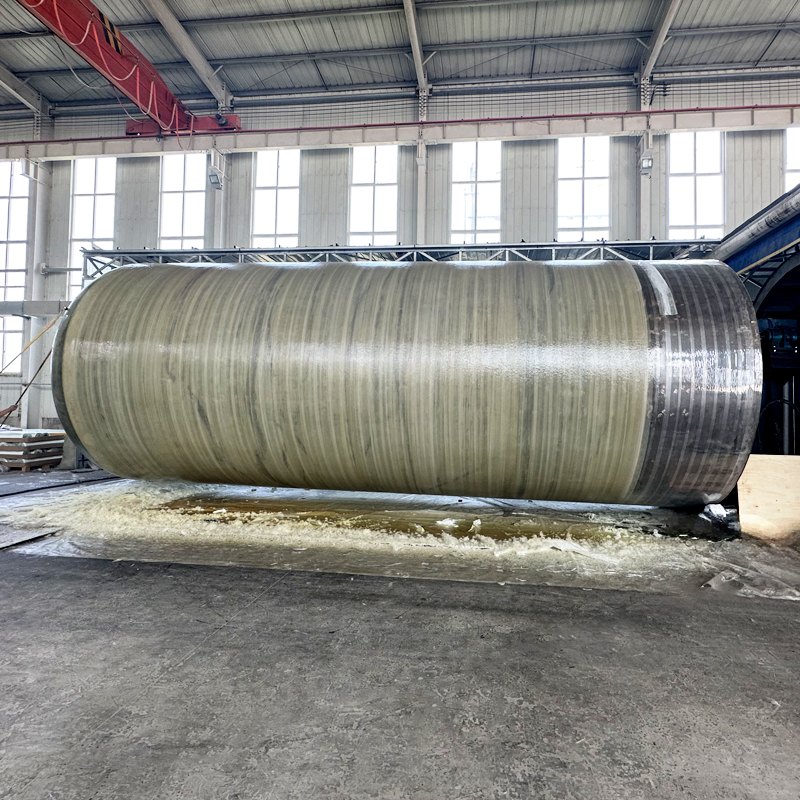
Raw material selection comes before any machine setting. The main materials include glass fiber roving, resin, surface mat, chopped strand mat, curing agent, pigments, UV additives, and release agent.
For chemical storage tanks, resin is not a minor detail. The inner liner must match the stored medium. Vinyl ester resin is often used for stronger chemical resistance, while polyester resin may suit less aggressive conditions. The final choice depends on liquid type, concentration, temperature, storage time, and whether the tank is indoors or outdoors.
Glass fiber roving carries most of the structural load. Poor roving tension, uneven fiber spreading, or bad resin wet-out can create weak spots inside the tank wall. Buyers planning a new FRP tank production line should confirm the local supply of resin, glass fiber, catalyst, and auxiliary materials before fixing the equipment layout.
Step 2: Mold Preparation and Inner Liner Forming
The mold surface must be clean, smooth, and properly coated with release agent. A dirty or damaged mold can leave marks on the tank surface and make demolding harder. For batch production, mold maintenance becomes part of daily quality control.
The inner liner is the first barrier against chemical attack. It normally includes a resin-rich corrosion-resistant layer and reinforcing mat. In chemical storage tank manufacturing, this layer should not be treated as a cosmetic surface. It protects the structural layer from direct contact with stored liquid.
The liner thickness, resin ratio, bubble removal, and curing time must be controlled. A thin liner may reduce cost at first, but it raises the risk of permeation and early repair. A thick but poorly cured liner can also fail. The right target is a dense, well-wetted, properly cured chemical barrier.
Step 3: Filament Winding for Structural Strength
After the liner reaches the required condition, the tank body moves into the filament winding process. Glass fiber rovings pass through a resin bath and are laid onto the rotating mold according to a programmed path. The machine carriage moves along the tank length while the mold rotates.
This stage builds the main structural wall of the tank. Winding angle, fiber tension, carriage speed, mandrel rotation, and resin pick-up all matter.
How Winding Angle Affects Tank Strength
A higher hoop winding ratio improves resistance to circumferential stress from liquid pressure. A more angled pattern adds axial strength and helps the tank body resist lengthwise loads. For chemical storage tanks, the winding design should match the tank diameter, length, installation method, liquid density, and service condition.
A production line that can adjust winding angle gives manufacturers more flexibility. Small horizontal tanks, large vertical tanks, water treatment tanks, and chemical dosing tanks do not always need the same structure.
Why Computer Control Improves Batch Quality
Manual adjustment may work for small batches, but it is harder to keep the same winding path across repeated orders. Computer-controlled filament winding helps keep fiber placement, angle, and carriage movement more stable. This is useful when a factory needs to produce several tanks of the same size for one project, such as a wastewater treatment station or chemical storage farm.
A stable winding process also helps reduce material waste. When the fiber path is controlled, operators are less likely to add excess layers only to compensate for uncertainty.
Step 4: Curing and Hardening
Curing gives the tank its final strength. Resin curing depends on resin type, catalyst ratio, workshop temperature, humidity, and time. In cold workshops, curing may be slow. In hot conditions, the resin may gel too fast, leaving less time for air removal and layer adjustment.
Poor curing can cause tacky surfaces, weak interlaminar bonding, cracks, or deformation after demolding. For chemical tanks, incomplete curing can also reduce chemical resistance. A reliable production line should include clear curing rules for each resin system, especially when the factory changes from water storage tanks to acid or alkali tanks.
Step 5: Demolding, Trimming, and Fitting Installation
After curing, the tank is released from the mold. Demolding must be controlled to avoid scratches, shell damage, or sudden impact. Large tanks often need lifting tools and enough space around the machine.
Next comes trimming and opening work. Chemical storage tanks usually need customized fittings, such as:
- Manholes for cleaning and maintenance
- Inlet and outlet nozzles
- Drain ports
- Vent connections
- Flanges
- Level gauge ports
- Reinforced saddles or support rings
The fitting area is one of the most common leakage points. Extra reinforcement around nozzles and flanges is often needed, especially for tanks used with corrosive liquids or frequent pipe vibration.
Step 6: Surface Finishing and Outdoor Protection
Surface finishing includes grinding, cleaning, repair, coating, and appearance checks. For outdoor tanks, UV resistance and weather protection should be considered. A tank installed beside a chemical plant may face sunlight, rain, acid mist, dust, and temperature swings.
A good outer layer does more than improve appearance. It protects the structural wall from environmental aging and helps extend service life. For export tanks, clean finishing also affects customer acceptance during factory inspection.
Step 7: Quality Inspection Before Delivery
Inspection should not wait until the tank is already packed. A practical FRP tank quality control routine checks the tank after each major stage and again before delivery.
Common inspection items include wall thickness, diameter, length, surface defects, liner condition, flange position, nozzle quality, leakage, and visible delamination. For chemical tank projects, buyers may also require records for resin batch, curing time, and inspection results.
| Defect | Likely Cause | Prevention |
|---|---|---|
| Dry fiber | Poor resin impregnation | Adjust resin bath and roving tension |
| Uneven wall thickness | Unstable winding speed or path | Use controlled winding settings |
| Bubbles in liner | Poor rolling or fast gel time | Control resin mix and air removal |
| Leakage near fittings | Weak reinforcement or poor sealing | Add local reinforcement and inspect joints |
| Surface cracks | Bad curing or handling impact | Set curing rules and improve lifting method |
Quality checks save cost. Finding a weak nozzle in the workshop is far cheaper than repairing a leaking tank after installation.
Choosing the Right FRP Tank Production Line
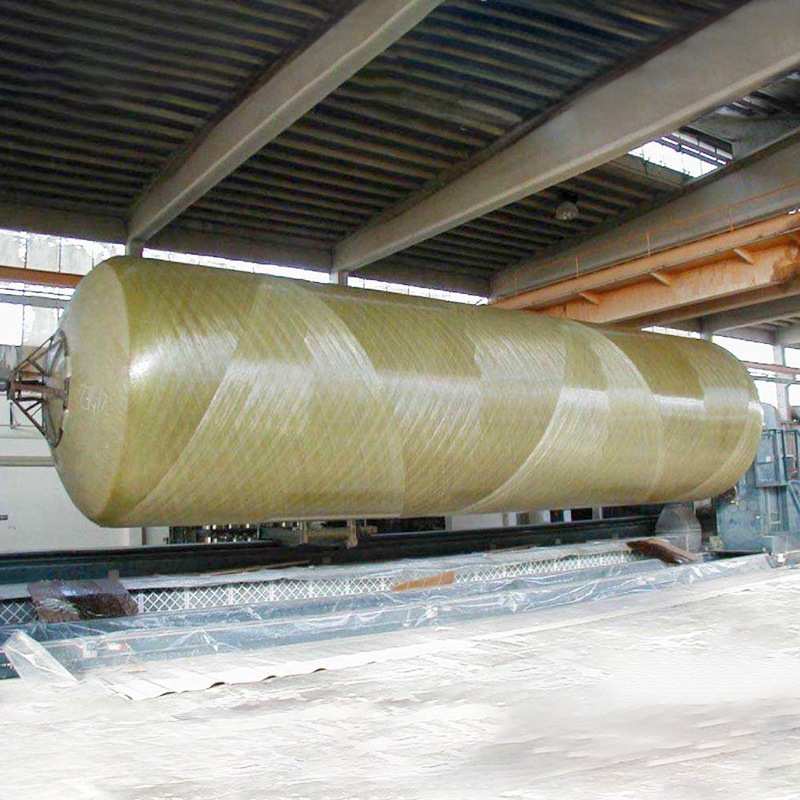 A buyer should not choose equipment only by machine price. A better decision starts with real production needs.
Important inquiry details include tank diameter range, maximum length, expected output, resin type, tank application, workshop size, local power conditions, and whether the project needs molds, installation guidance, or training.
For example, a manufacturer serving water treatment contractors may need flexible production for dosing tanks, wastewater tanks, and sodium hypochlorite tanks. A chemical plant supplier may need larger tank sizes, higher liner quality, and stricter fitting control. A factory doing export orders may care more about repeated batch quality, clean appearance, and inspection records.
The right FRP tank production line should match daily products, not only the largest possible tank size.
Hebei Aoliande as an FRP Tank Filament Winding Machine Supplier
Hebei Aoliande Chemical Equipment Co., LTD. supplies equipment for chemical production lines and FRP/GRP product manufacturing. Its product range covers FRP pipe and tank filament winding machines, FRP molded grating machines, pultrusion machines, rebar machines, chemical production line equipment, molds, and related production systems.
For FRP tank manufacturers, this background is useful because tank production is closely tied to materials, structures, molds, process control, and after-sales support. The company combines manufacturing capacity with design support for materials, structure, and finished products. Technical advice, goods and material supply, transportation, and installation supervision can help buyers build a more complete production setup instead of purchasing isolated equipment.
The company’s FRP tank filament winding equipment is designed for computer-controlled winding, automatic winding path design after parameter input, coordinated movement between the main shaft and carriage, and stable production of medium and large tank bodies. This makes it suitable for manufacturers that need corrosion-resistant storage tanks for chemical plants, water treatment projects, industrial liquid storage, and related composite tank applications.
Conclusion
An FRP chemical storage tank production line must control every step from raw material selection to final testing. The inner liner provides chemical resistance. The filament winding process builds strength. Curing, trimming, fittings, and inspection decide whether the finished tank can work reliably in real industrial service.
For buyers, the best production line is not simply the biggest or cheapest one. It is the line that fits the target tank sizes, chemical media, output plan, workshop layout, and quality standard. A well-matched FRP tank filament winding machine can help manufacturers produce stable, corrosion-resistant tanks with lower rework risk and better long-term customer trust.
Questions fréquentes
What equipment is needed for an FRP chemical storage tank production line?
A typical FRP chemical storage tank production line needs tank molds, a resin mixing system, glass fiber feeding, a resin impregnation unit, an FRP tank filament winding machine, curing space, trimming tools, fitting installation tools, and testing equipment. Large factories may also need lifting equipment, dust collection, material storage, and dedicated inspection areas.
What is the most important step in the FRP tank manufacturing process?
The inner liner and filament winding process are both critical. The inner liner gives chemical resistance, while filament winding gives the tank body its main strength. If either step is poorly controlled, the finished fiberglass chemical storage tank may face leakage, delamination, or early corrosion damage.
How does winding angle affect an FRP chemical storage tank?
Winding angle affects how the glass fibers carry stress. Some angles improve hoop strength for liquid pressure, while other patterns add axial strength. The right winding design depends on tank size, installation method, liquid density, and service condition.
Which resin is suitable for chemical storage tanks?
The resin should match the stored liquid, concentration, temperature, and working environment. Vinyl ester resin is often chosen for stronger chemical resistance, while polyester resin may be used for less aggressive storage duties. The final resin system should be selected according to the actual chemical medium.
How should buyers choose an FRP tank filament winding machine?
Buyers should check tank diameter range, maximum tank length, winding control, positioning accuracy, roving width, output capacity, mold compatibility, after-sales support, and installation guidance. A useful inquiry should include tank drawings, target production volume, chemical application, workshop size, and local power conditions.