
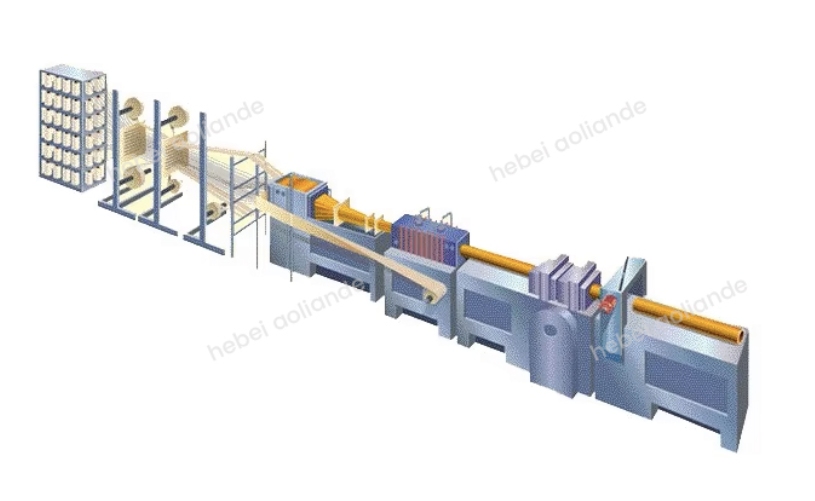
FRP pultruded profiles should appear clean, retain their shape and function in harsh environments like cable raceways, chemical plants, cooling towers, walkways for bridges, solar arrays, and industrial platforms. A profile with a smooth surface, free from bubbles, cracks, voids, exposed fibers and peeling, looks good but also ensures that the basic requirements for its production have been met, i.e. good resin wet-out, proper fiber alignment, uniform heating of the die, constant pulling speed and sufficient traction force.
Small defects in GRP pultruded profiles manufactured in batch can rapidly become a major problem for factories. They can lead to entire orders being returned to the supplier, increased time spent in the cutting area trimming defects, late delivery, and variable mechanical properties. The defects may not be immediately apparent on visual inspection, and may only become apparent when in use. Voiding and poor curing out can significantly reduce the interfacial shear stress between adjacent profiles and can lead to early deterioration of the joint.
Minimizing defects in FRP pultrusion production is a holistic process that involves matching a number of factors including the raw material condition, the resin behavior, fiber path, mold design, heated die temperature, pulling force and machine control. This guide explains how in practical terms on a daily basis in a factory, surface defects such as bubbles and cracks and other surface defects in FRP profiles can be reduced by checking a number of key production parameters.
Why do surface defects matter in FRP pultruded profiles?
Surface defects on pultruded profiles can indicate that the processing is moving outside of a stable processing window. A small number of bubbles on the surface could be due to trapped air, a rough surface finish could be due to dry fiber or poor resin flow, and a crack in the surface could be due to the outer surface of the profile gelling too quickly whilst the inner sections of the profile are still in the reacting or gel state.
Defects affect more than appearance
FRP pultruded profiles are usually selected by industrial buyers because they are light, corrosion resistant and have a long service life. Recurring defects such as bubbles, cracks and fiber exposure affect not only the surface finish but also the whole production process.
Typical risks include:
- Lower strength in loaded profiles such as beams, brackets, and supports
- Poor bonding between resin and glass fiber
- Higher water or chemical ingress through surface cracks
- Unstable dimensions during installation
- More scrap, rework, and customer complaints
A clean profile is an important buying criterion, especially if a product is to be used outdoors, in corrosive environments or under heavy loads.
What common FRP pultrusion defects should be checked first?
Identify the defect first before making changes to process settings. While the symptoms of bubble, void, crack, surface roughness and fiber exposure appear to be alike, they have different root causes.
| Defect | What operators see | Likely process cause |
|---|---|---|
| Bubbles | Small raised spots or air pockets on the surface | Moisture, trapped air, poor resin impregnation |
| Voids | Tiny holes or hidden internal gaps | Incomplete wet-out, high resin viscosity, weak compaction |
| Cracks | Fine lines, splitting, or surface crazing | Uneven curing, high internal stress, wrong pulling speed |
| Rough surface | Dull, uneven, or scaly finish | Mold wear, resin starvation, poor fiber alignment |
| Fiber exposure | Glass fibers visible on the outside | Low resin coverage, dry fibers, poor guiding |
| Peeling | Surface layer flakes or lifts | Mold contamination, poor release, unstable curing |
A simple defect log is sufficient. Write down the type of defect, the time when it occurred, die temperature, pulling speed, resin batch, fiber batch, mold and operator shift. After a few days you will most likely see some patterns.
Why do bubbles and voids appear in FRP pultrusion?
Bubbles that occur in FRP pultrusion production are usually trapped air or vapor that has not been able to escape from the mold before the resin has cured. The bubbles can appear on the surface of the item produced or be trapped inside the profile as voids. In either case, the bubbles interfere with the bond between the fibers and the resin.
Poor resin wet-out
Resin wet-out occurs when dry glass fiber is converted into a composite part. During this process the resin penetrates the fiber bundle, coats individual fibers and releases air that can become trapped between fibers and bundle surfaces. The resin only wets the outside of the roving when the roving remains dry in places, even though the surface of the part appears to be wet properly.
Some common causes of poor fiber penetration include high viscosity of resin, low resin in tank, poor fiber spread, and inadequate contact time. Fibers with thick bundle cross-sections and yarns following very tight paths are particularly sensitive to these conditions.
Moisture in fibers or fillers
Moisture in the form of vapor causes bubbles. Wet glass fibers, fillers and pigments can, when heated in a die, develop in the form of air into vapor. Surface defects in the form of small blisters or scattered pores can be caused by this type of defects.
In factories storing dry rovings, fillers, etc. and opened resin or additives drums in workshops that are very humid must be avoided. In rainy season, storing of materials is as important as the setting of the machines.
Pulling speed is too high
Increasing the pulling speed causes fibers to remain less time in the dipping tank and in the heated die. The resin will not have enough time to seep into the fiber bundle and to harden uniformly. Even though increased output is desired, it generates large amount of voids, causes fibers to dry and forms surface porosities.
A better approach is to raise speed step by step and check surface quality, hardness, pull force, and cut-end appearance after each change.
Why do FRP pultruded profiles crack?
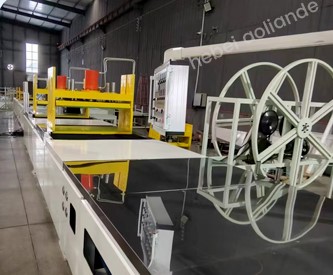
Internal stress is the main cause of cracks in FRP pultruded profiles. When pultruded profiles are heated, cured, pulled and shaped all at the same time, the outer surface of the profile can cure at a different rate than the inside of the profile. As a result stress is developed.
Uneven die temperature
The heated die controls resin curing. If the inlet, middle, and outlet zones are not matched well, the profile can cure too early or too late. A surface that cures too fast becomes rigid while the inner material is still reacting and shrinking. This can lead to fine cracks or deeper splitting.
Thick rods, square tubes, I-beams, as well as profiles of varying wall thicknesses require more control of temperature than thin flat strips. Heat must penetrate inside of article while avoiding over-curing of outside surfaces to prevent burning.
Pulling speed and curing time do not match
The pulling speed influences the time a profile is in the heated die. If the pulling speed is too high, a part may leave the die under-cured. If the pulling speed is too low, the surface may become too hot and stick to the die. Both cases can cause cracks, warping or a bad surface finish.
A stable FRP/GRP pultrusion machine is one where you can run at any speed without having to switch to a fixed production speed.
Resin formulation is not suitable for the profile
To achieve correct parts, the correct resin system must be matched to the profile size, fiber content, filler content, and die temperature. A fast setting system may work on small profiles but cause undue stress in thick sections. A slow setting system can produce soft surfaces, resin drag, and poor cutting.
When cracks appear after you have changed your resin, your filler, your pigment or your working environment, investigate your material formula first before you complain about your mold.
How do pulling speed and die temperature work together?
Pulling speed and die temperature form the center of FRP pultrusion quality control. One affects residence time. The other affects resin reaction. Changing only one setting without checking the other often creates new defects.
A practical way to read process changes
Bubbles: This could be a sign that material is not getting enough time for wet-out or cure. Cracks: This could indicate that the cure reaction is too aggressive at too high of a die temperature. Surface becomes rough after long shift: Either the mold is fouling or the resin bath has changed viscosity.
In daily production, teams should track:
- Pulling speed before and after each adjustment
- Die temperature by heating zone
- Pulling force trend during the shift
- Resin bath viscosity and pot life
- Surface condition at the die exit
- Cut-end quality after cooling
A pultrusion line with digital traction speed display and stable speed control enables the ohttps://www.sopplant.com/perator to link defects with process data. Without this, troubleshooting is in the dark.
How can surface defects be reduced during daily production?
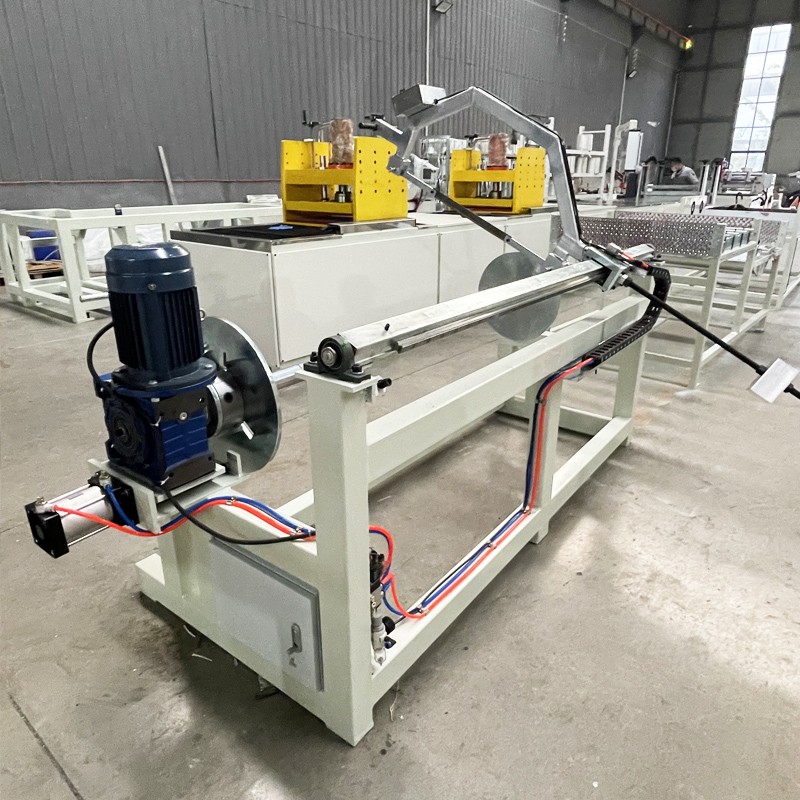
Surface defects on FRP profiles can be reduced by conducting routine checks in a disciplined fashion. It is best to identify and remedy the smallest defects at the earliest sign of trouble rather than allow the profile to be damaged severely.
Keep the fiber path smooth
Prior to entering the resin bath, fibers must be unraveled and guided in an untwisted, non-intersecting and constant tension configuration. If the fibers are not properly aligned, so-called “dry areas”, “fiber bunching”, “resin-rich areas” and a rough surface finish can occur.
Regular daily cleaning and checking of the guide plates, yarn frames and the preforming tools is essential. If one roving path is running tighter than the others then this may result in lines, weak points or even exposed fibers in the completed profile.
Control the resin bath
A proper dipping tank is one that has enough resin contact, a stable resin level and proper viscosity. A resin bath that thickens during the shift will slowly wet fibers. A resin level that drops too low will cause some of the fibers to be sent through dry.
To achieve better impregnation the operator should check temperature of the resin, mixing time, filling of the fillers, presence of bubbles in the tank as well as the pressure on the fiber bundles. Simply soaking of the fibers is not sufficient for repeatable wet-out of the fibers from the start of the order to the end of the order.
Maintain mold surface condition
A worn or dirty mold surface will develop scratches, fiber drag, peeling and rough texture. The die surface condition is the most critical factor when manufacturing visible profiles like handrails, ladders, wall and roof support frames, photovoltaic profiles and cable trays.
A defect that occurs at the same place on a part’s profile should be investigated for the cause of the defect in the mold. Such a cause could be hardened resin, local wear, bad polishing, a clogged release, or damage at the mold inlet.
What should buyers check in an FRP/GRP pultrusion machine?
Pultrusion equipment does more than pull fibers through to make a part. It supports the rest of the production line, from raw material opening to the cut part. When purchasing to support new production or to replace outdated machines, it is wise to consider quality control in your purchasing decision.
Key machine sections linked to defect control
| Machine section | What to check | Why it affects profile quality |
|---|---|---|
| Creel and fiber guiding | Smooth roving path and stable tension | Reduces fiber disorder and dry spots |
| Dipping tank | Resin contact and wet-out support | Helps prevent bubbles and voids |
| Mold table | Stable heating and mold support | Reduces cracks and dimensional drift |
| Traction system | Steady pulling force and speed | Controls curing time and surface marks |
| Cutting unit | Fixed-length cutting and stable pressing | Reduces end damage and handling defects |
| Control system | Clear display and alarms | Helps operators react before scrap increases |
This line has PLC control, LCD display, hydraulic reciprocating traction, pneumatic fixed-length cutting, high-precision temperature control and digital traction speed display. This gives the operator the freedom to manage real production changes. A number of profiles can be produced on one line, such as wire troughs, round rods, I-beams, angle profiles, square tubes, round tubes, hollow panels, bridge profiles and photovoltaic supports.
Hebei Aoliande Chemical Equipment Co., LTD. as an FRP/GRP Pultrusion Machine Supplier
Хэбэй Aoliande Chemical Equipment Co., LTD. is the specialized manufacturer which provide equipment for production of FRP/GRP profiles and other kinds of composite material productions. Our FRP/GRP pultrusion machine is integrated in one production line, which is to complete all work process from fiber putting to finished product supporting, and all process work is in sequence with each other and completed by one time work.
For manufacturers, this integrated structure is practical. The defects in production can be reduced by working together as a team in the various sections of the factory. A stable traction to maintain the line rhythm is very important. The accurate temperature control is also very important in order to cure the material properly. Adjustable speed of production line can be set in order to produce profiles of different sizes. Pneumatic fixed-length cutting of ends after forming can prevent any damage to the produced profiles. Various molds are also available to be used in factories in order to produce different cross-sections of profiles to be used in industrial, construction, electrical and renewable energy applications.
The supplier provides support not only for equipment supply but also for FRP/GRP product machinery and chemical production line systems. The supplier provides technical advice, supplies necessary equipment, arranges for transportation and supervises installation. For new buyers to FRP profile production or for those who are expanding their current plant, the supplier’s background can save them from trial-and-error when designing the plant layout, selecting the proper equipment and starting up production.
Вывод
Bubbles, cracks, and surface defects in FRP pultruded profiles rarely come from one single cause. They are usually the result of small process errors building up across fiber feeding, resin wet-out, mold heating, pulling speed, curing, traction, and cutting.
You may like a cleaner FRP profile. To check whether a cleaner FRP profile is feasible in your plant, please check the following points: dry raw materials, smooth fiber routes, correct resin viscosity, die temperature, pulling speed, clean mold surfaces, and traction force. When all these points are under control, a good surface finish, less voids, better bond, and more consistent batch quality can be achieved.
The machine should enable the buyer to control the process in daily production. This means that the machine has to allow for constant speed, has to have a reliable hydraulic traction, constant temperature, clear display, cutting facilities etc. In this way scrap can be kept to a minimum and the finished profiles will have better consistency.
Часто задаваемые вопросы
What causes bubbles in FRP pultruded profiles?
Bubbles in FRP pultruded profiles are primarily due to trapped air, high content of moisture in fibers or fillers, high viscosity of the resin, poor wetting out of the fibers by the resin, and too high pulling speed. Initial diagnosis can be based on the status of the resin bath, the storage of the materials, the fiber tension and the die temperature.
How can cracks in FRP pultruded profiles be reduced?
To prevent cracks, it has to be taken account of while pulling off the mold, that the pulling off speed corresponds to the respective curing time of the coating, the die temperature profile is chosen correctly and not too aggressively heated. When checking the coating formulation it has to be asked, whether it is suitable for the respective profile thickness. Thick FRP profiles require a wider process window than thin profiles.
Why does the surface of an FRP profile become rough?
A rough surface could be caused by a variety of factors including dry fibers, low resin content on surface, mold wear, fiber misorientation and resin that has stuck to the die surfaces. Surface quality, resin viscosity, fiber alignment, and preforming quality should be inspected before making any major process change.
Does pulling speed affect FRP pultrusion defects?
Yes. Pulling speed is a major factor in determining how long fibers and resins are in contact with the die where they are heated. At too high of a pulling speed, fibers and resins may not fully wet out and cure properly. At too low of a pulling speed, die surfaces can become too hot, cause materials to stick, or produce surface defects. Stably controlling pulling speed is therefore important for preventing FRP pultrusion defects.
What should buyers look for in an FRP/GRP pultrusion machine?
In particular, it is good to check creel, dipping tank, mold table, traction, cutting unit, temperature control, speed indicator, control system and the supplier’s service. A stable FRP/GRP pultrusion machine is able to continuously produce of consistent quality during long hours of operation, with consistant resin impregnation, curing, pulling and cutting.