
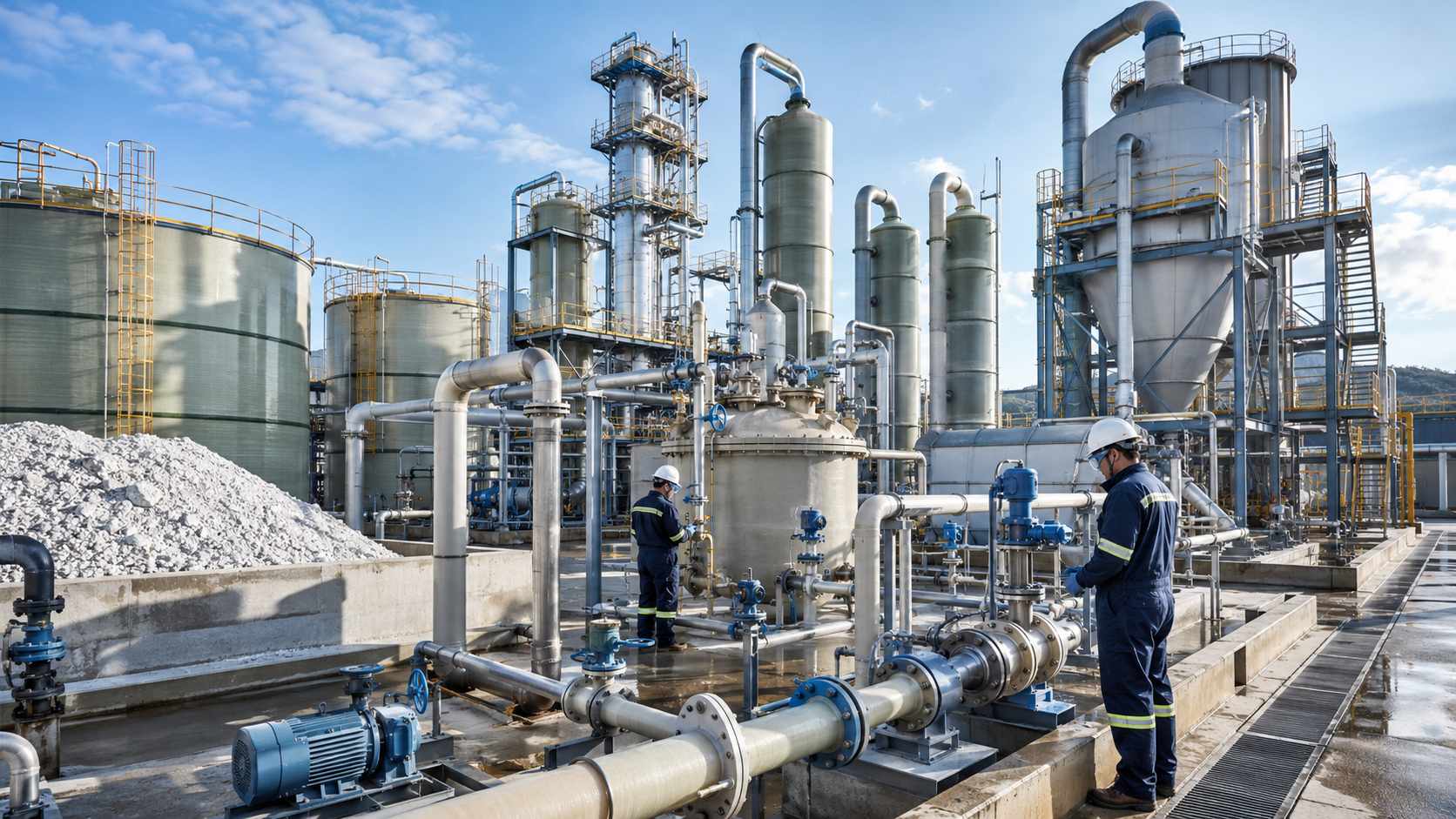
Producing Calcium Chloride is not simply the reaction between limestone and hydrochloric acid. There are many bigger problems in the operating of a production plant such as corrosion, hot liquids, acid mist, wet dust, and fouling in drying systems. On a simple flow diagram a Calcium Chloride production line may appear easy to operate, however in reality there are many storage tanks for acids, heat from the reaction, high chloride content of the process liquor, evaporation, granulation, washing of tail gases, and the greatest problem of all, the moisture sensitive product.
Corrosion and safety design of process equipment should be designed before the respective items of equipment are ordered. The material of construction of a storage tank, the lining of a process pipe, the seal of a centrifugal or positive displacement pump and the exhaust of a dryer all contribute to plant running smoothly or being the cause of frequent plant shut downs. For the prospective buyer of new equipment for a calcium chloride plant, these factors relate to the items of equipment in question to long life, good product, low maintenance costs and safe working practices.
Why Corrosion Control Matters in Calcium Chloride Production
Corrosion in calcium chloride production is a multi-faceted problem. Storage tanks and dosing equipment are attacked by the hydrochloric acid. The hot CaCl2-liquor creates a high-chloride environment for all pumps, pipes, valves and evaporators. Acid mist can easily penetrate into neighboring buildings if the reaction area is not completely enclosed and regularly washed. The drying section in particular generates high temperatures, large amounts of dust and high moisture levels, thus exacerbating local corrosion attacks.
The potential for damage to equipment is not the only risk associated with leakage. A leaking acid line could shut down production for hours. A worn pump seal could release a hot solution of calcium chloride as a fine powder or as an acid mist. Corroded duct work could also release acid mist or a fine powder into the workshop. Iron from contact with unsuitable metal could also contaminate the product, particularly if a high grade of anhydrous calcium chloride is being made.
Corrosion from calcium chloride in a plant should be viewed by the owner as a production cost and not as a maintenance cost. A lower initial cost of the equipment will only result in more down time, more spare parts and a shorter life for the equipment.
Main Corrosive Zones in a Calcium Chloride Production Line
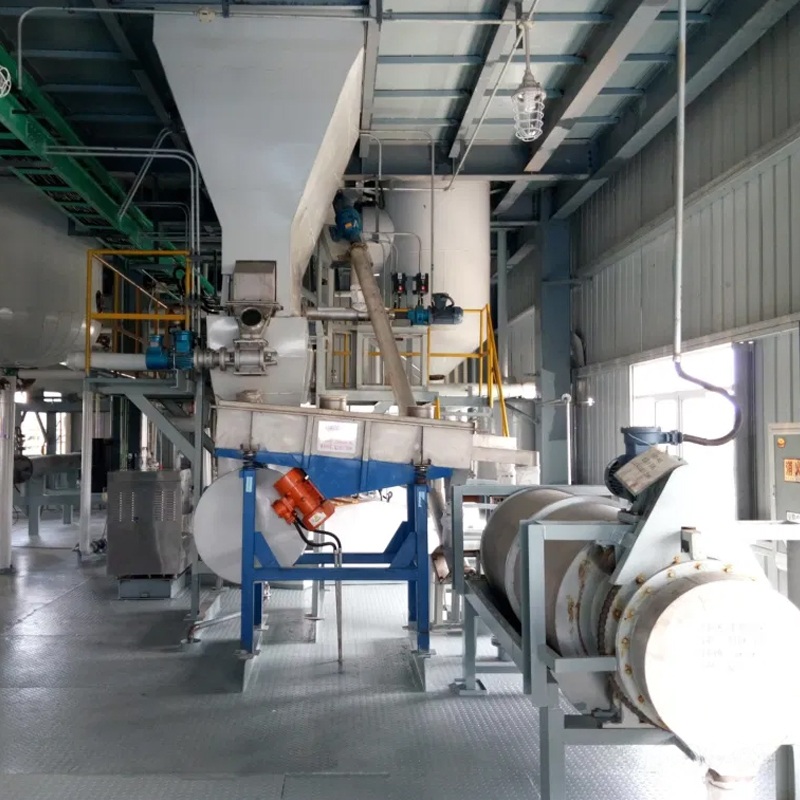
A typical calcium chloride production line has several corrosion areas, and all of these areas must be evaluated for the appropriate material and safety aspects.
HCl Storage and Dosing Area
Hydrochloric acid storage is one of the most sensitive sections. Tanks, unloading lines, dosing pumps, valves, flanges, level gauges, and vents all need acid-compatible materials. The right choice depends on acid concentration, temperature, impurities, pressure, and whether the equipment is indoors or outdoors.
Many plants use non-metallic materials, lined steel or corrosion resistant composite structures for their acid service applications. Ordinary carbon steel is not suitable for exposure to HCl and many of the more common stainless steels require similar careful consideration particularly with respect to acid concentration and temperature. It is the small parts which cause most concern. A poor quality gasket, a wrong bolt sleeve or a incorrectly selected instrument fitting can all be the first point of leakage.
Sealed unloading connections, acid-resistant flooring, a sump for acids in the storage area, vent scrubbing, clearly marked piping, and emergency deluge shower with eye wash station located nearest to acid storage area.
Reaction and Neutralization System
Add section describing how limestone and hydrochloric acid react to form a solution of calcium chloride whilst producing a gas and heat. Section should outline controlled addition of acid, stable mixing, safe venting of gas, and ability to regularly remove insoluble solids from the solution.
-Too rapid acid feed can result in local high acidity which can attack other plant items. – High insoluble impurities in limestone will cause frequent blockages of filters and pipelines. – Insufficient release of gaseous products from reaction can result in mists returning to workshop. This would involve inspection of the reaction tank, agitator, vent line, filter system and scrubber.
A stable reaction zone is critical to ensure safety as well as product quality. It helps to prevent the unwanted transfer of free acid, solids or foaming problems to the subsequent evaporation or drying steps.
Evaporation and Hot CaCl2 Liquor Handling
Hot CaCl2 liquor is often harder to manage than cold acid in daily operation. It is dense, chloride-rich, and handled at elevated temperature. Leakage can burn skin, damage insulation, and leave sticky deposits that attract moisture.
Check pumps, heat exchangers, evaporators, etc. for signs of chloride corrosion, scaling and thermal shock. Avoid dead legs as liquor in these areas can concentrate and form unwanted deposits. Check that flanges are accessible. Protect insulation from liquid penetration. Wet insulation can hide major corrosion before it is too late by the time pipe walls have thinned significantly.
In addition to safe operating practices, operators require safe drain points, splash guards, relief, temperature alarms and clear lockout/tagout procedures for maintenance.
Material Selection for HCl and Hot CaCl2 Service
No single material will satisfy all needs for calcium chloride production. Material choices are largely dictated by the specific service requirements.
| Plant section | Main risk | Material and design focus |
| HCl storage | Acid corrosion, acid mist | Acid-resistant lining, non-metallic tank options, vent washing |
| Reaction tank | Acid attack, heat, gas release | Corrosion-resistant lining, controlled feeding, covered venting |
| Filter and slurry line | Solids wear, local acidity | Wear-resistant design, easy cleaning, suitable pump seals |
| Hot CaCl2 liquor | Chloride corrosion, scaling, burns | Temperature-rated materials, drain points, leak collection |
| Dryer and duct | Heat, dust, humid exhaust | Dust recovery, treated exhaust, corrosion-resistant duct sections |
When specifying corrosion resistant materials for HCl, the buyer should provide the following information: the acid concentration range, the source of the acid, an impurity report, the operating temperature, and the method of cleaning. The impurities present in acid from different sources must be known when selecting equipment. Test the by-product HCl from processes such as chlor-alkali, phosphorus chemical, chloroacetic acid, sulfate, and bleaching powder before selecting the final equipment.
In addition to the dilute solution, consideration must be given to the concentration and temperature of the solution after evaporation. A number of materials that are adequate for use in hot calcium chloride solution of dilute concentration may not be so suitable for use with concentrated solution. It is generally incorrect to regard the pump seals, valve seats, gaskets and expansion joint items as relatively small items and to treat them in a cavalier manner. They are the first items to fail.
Drying System Safety: Heat, Dust, and Moisture
The drying system for the calcium chloride product is the spot where quality of the product and safety of the plant are brought together. As calcium chloride is a hygroscopic product, it can absorb a lot of water in a short period of time and powder or granulated product which is wet, can stick to each other, can stick to the wall of a bin or can stick in a discharge point and even can get cake-like in form. As anhydrous form of calcium chloride is produced in this plant, in order to get the above-mentioned form, water must be removed from the product, and the product must be shaped in such a form that it does not break while it is in storage.
Fluidized bed spray drying are often used for the above reasons. To increase heat exchange, to support a stable particle formation and to handle changes in the feed moisture a good calcium chloride granulation system is required. The most critical area for control of fluidized bed drying is the air distribution to the bed. Should the bed not fluidize evenly, areas of the bed can become wet leading to the formation of very large lumps, poor drying and extra cleaning.
Key drying system checks include:
- stable feed concentration and flow rate
- even air distribution across the bed
- safe outlet gas temperature control
- dust collection before exhaust release
- moisture-proof cooling, screening, and packing
- access doors for cleaning without unsafe entry
Dust control is also an important safety consideration. A fine dry dust such as calcium chloride is hygroscopic; it will absorb moisture from the air and deposit on surfaces. If the exhaust from a dryer is not properly treated, material loss will increase, and the workshop will become a dirty place to work.
Tail Gas, Acid Mist, and Environmental Safety
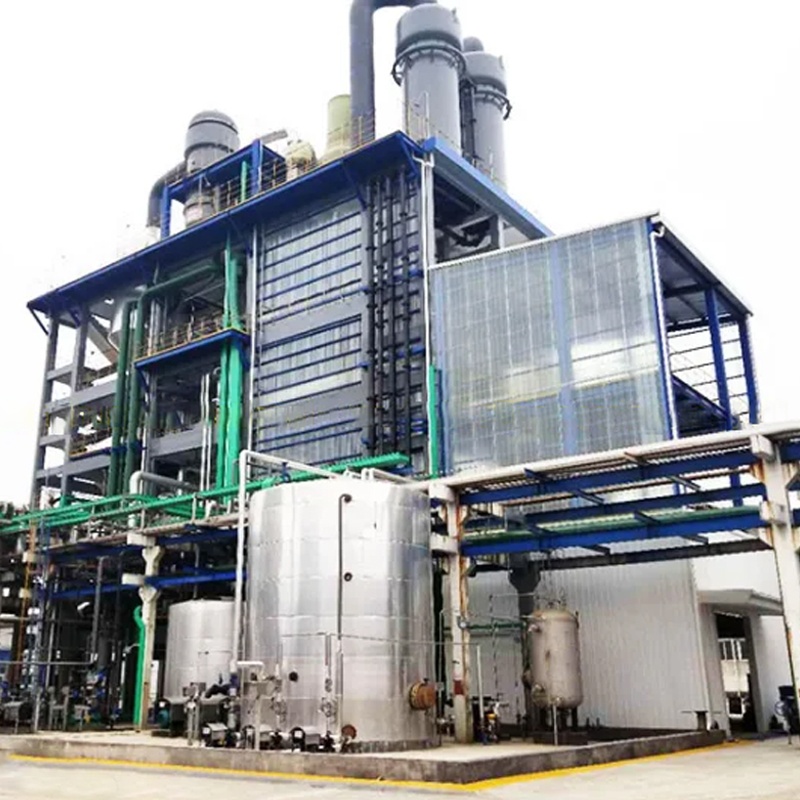
Tail gas washing is an integral component of safe calcium chloride production. The reaction section can generate gas which contains acid mist and the drying section can generate hot humid exhaust containing fine material. Both of these must be properly collected and treated.
Controlling acid mist begins with covering reaction equipment and making sure the venting is stable. The scrubber must be sized for the actual volume of gas that is produced by reaction, as opposed to the theoretical amount of reaction. In addition to the scrubber, it is also important to make sure that the rest of the exhaust system is properly sloped and has proper drain points as well as ports for inspection to prevent the liquid from pooling and causing corrosion.
For the drying section, a dust collection system can help to prevent material loss while also ensuring that emissions from the exhaust from the drying section are kept clean. The exhaust should leave the plant with as much of particulate and corrosives removed as required. The wash liquid from the separation of solid from liquid or the collected drainage water should be treated in a neutralization system or recovery system.
Safety Checklist Before Ordering a Calcium Chloride Production Line
A technical checklist must be compiled before purchasing a calcium chloride production line in order to prevent many potential problems.
| Item to confirm | Why it matters |
| HCl source, concentration, and impurities | Decides tank, pump, pipe, and reaction design |
| Limestone quality and insoluble content | Affects filtration, scaling, and product purity |
| Target product form | Changes drying, granulation, cooling, and packing needs |
| Required purity level | Affects reaction control, filtration, and contamination control |
| Local emission rules | Decides tail gas washing and dust collection design |
| Available steam, power, water, and air | Affects layout and equipment sizing |
| Maintenance skill level | Influences automation, access, and spare parts plan |
A good design would also include Emergency Showers and Eye Wash Stations, Acid Resistant Flooring, Containment around tanks, Safety Signs, Interlocks for Temperature and Pressure, and clear Operating Instructions for the unloading of Acid and the Hot Liquor Maintenance.
Hebei Aoliande as a Calcium Chloride Production Line Supplier
Hebei Aoliande Chemical Equipment Co., LTD. is a supplier of industrial production equipment for chemical and composite materials. Our main products include equipment for the production of calcium chloride, equipment for the production of potassium/sodium sulfate, sulfuric acid production lines, water soluble fertilizer production lines and equipment for FRP/GRP.
For the production of calcium chloride we can offer a process route based on hydrochloric acid and limestone. This process route includes the production of a liquid calcium chloride solution as well as the production of anhydrous calcium chloride in granular form. This also includes the design of pipelines, the electrical installation, the measuring and control equipment, the relevant valves and all other equipment as well as the utilities and environmental protection measures. The plant can produce anhydrous calcium chloride with a purity of more than 95%. The tail gas can be desulfurized and washed prior to discharge into the atmosphere.
The line also accepts hydrochloric acid from several industrial sources, including acid from chlor-alkali production and by-product acid from related chemical processes, subject to project testing and matching. This is useful for plants that want to turn by-product HCl into a saleable calcium chloride product instead of treating it only as a waste stream.
Hebei Aoliande has the capability of manufacturing, providing materials, structures and product designs. As suppliers, we are also able to provide buyers with technical advice, material supply, transportation and installation supervision as a complete project. This allows buyers to check corrosion resistance, plant layout, main equipment selection and commissioning details all within one project plan.
Conclusion
A reliable calcium chloride production line is more than just production capacity. It also requires suitable storage for HCl, safe handling of hot CaCl2 liquor, a suitable drying system, efficient tail gas washing and adequate protection of the operators. When planning a production line, corrosion and safety issues should be discussed at the very start of the project, when all relevant factors such as materials, layout, utilities, automation and emissions can still be planned.
When inquiring for a new calcium chloride plant, the most important information that the supplier needs to give a safe and practical offer are the HCl concentration and the acid source, as well as the analysis of the limestone to be used, the capacity required, the form in which the product shall be delivered, the required purity, the local emission regulations and the available utilities.
FAQs
What materials are used in a calcium chloride production line?
The materials used for equipment in the process section depend on the process. For example HCl storage tanks may require acid-resistant linings or be made of non-metallic materials. The hot CaCl2 liquor section requires materials resistant to attack by the chloride solution at operating temperature. When specifying pumps, valves, gaskets, seals and other items such as ductwork, consideration must be given to the concentration of the solution, the temperature, the pressure, the presence of solids and the method of cleaning.
How do you prevent corrosion in a calcium chloride plant?
Reduction of corrosion can be brought about by use of proper materials for each service condition, by control of the amount of acid being fed to the process, by removal of all insoluble solids from the process effluent, by elimination of all dead spaces in pipe work, by proper protection of all insulation against leakage, and by proper tail gas washing. All pump work, flanges, duct work and drain points must be regularly inspected for signs of deterioration or leakage.
Why is hot CaCl2 liquor a safety concern?
This liquid at high temperatures can cause severe burns, penetrate electrical cable insulation, form very sticky deposits, and will increase the normal chloride corrosion. Safe handling includes monitoring of temperature and pressure and the use of splash shields, correct connected / open drains, clear steps for maintenance, and adequate equipment for emergency situations.
What is the role of spray fluidized bed drying?
Spray fluidized bed drying enhances the contact between the material to be dried and the hot gas. This promotes the heat transfer and also the granulation. For the drying of calcium chloride a good air distribution is important. It prevents wet areas, stabilizes the particles and prevents the formation of over-sized lumps or agglomerates of the material.
Why is tail gas washing important in calcium chloride production?
Tail gas washing can be used to treat acid mist, humid exhaust gases, and fine particulate matter generated in reaction and drying sections. The objective of tail gas washing is to protect employees, to reduce loss of material, to enable cleaner disposal of the treated gases and to minimize risk of corrosion to nearby equipment and building structures.