
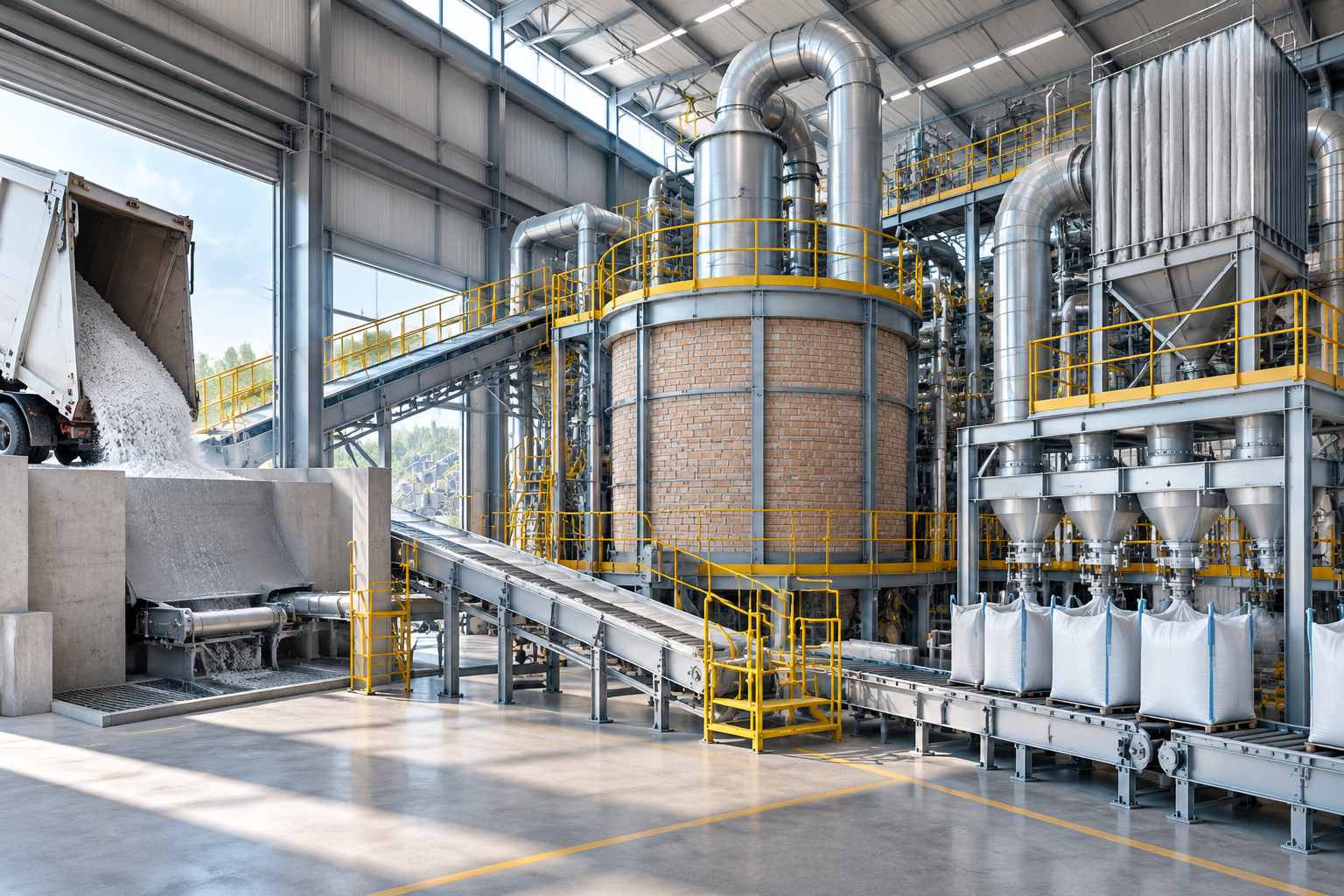
A low-dust fertilizer workshop is planned around where dust is created, how it moves, and how operators can clean equipment without sending settled material back into the air. For a Mannheim potassium sulfate plant, the workshop must connect KCl receiving, acid reaction, product cooling, screening, packing, and hydrogen chloride recovery. A potassium sulfate production line should therefore include dust control in the process design, not as a late building upgrade.
Why Workshop Layout Changes Dust Exposure
Dust becomes difficult to control when transfer points, inspection doors, bag filters, and pedestrian routes are mixed in one narrow aisle. A truck unloads salt at one end, a screw feeder moves it to the furnace, and product falls through several levels before packing. Each drop adds air movement. A good layout shortens open transfer distances, keeps maintenance access clear, and gives extraction air a defined path.
| Workshop zone | Main dust source | Layout response |
| KCl receiving | Unloading, sampling, and spillage | Covered bay, local extraction, sealed transfer |
| Feed preparation | Hopper refill and feeder inlet | Enclosed hopper, low-drop chute, service platform |
| Mannheim furnace | Rake discharge and hot solids | Hooded discharge, protected inspection points |
| Cooling and screening | Product fines and screen overflow | Enclosed cooler, negative-pressure casing |
| Verpackung | Bag filling and rejected bags | Filling head extraction, clean aisle, dust return |
Keep forklift lanes away from settled-powder surfaces where possible. Vehicle traffic can lift dust that has already left the process. Floors should have a smooth finish and a planned vacuum route; compressed-air cleaning only moves the problem from one surface to another.
Start with a Dust Source Map
Walk the proposed line while asking a simple question: where does solids flow change direction, speed, temperature, or containment? Mark every chute, screw outlet, rotary valve, screen, sampler, and bag connection. Then record whether the point is open, partly enclosed, or sealed.
The source map should also show hot surfaces and acid-bearing gas. A hood near a Mannheim discharge must tolerate heat and corrosive carryover. A hood over a cold packing line has a different air volume and filter selection. Treating both as the same pickup often creates noisy fans and weak capture at the point that needs it most.
Operators notice clues before an engineer sees a drawing. A white line on a beam, a dust ring around an inspection cover, or a product pile below a flexible sleeve identifies leakage. Add these observations to the design review instead of relying only on nominal equipment data.
Enclosure and Airflow Choices
Containment is usually more reliable than trying to collect a large cloud after it has formed. Chutes should be steep enough for the product, with inspection doors that close against a gasket. Flexible connections need a defined replacement interval because a small split can spread dust across a whole level.
Use a pressure hierarchy: the dirtiest enclosure is slightly negative to the surrounding room, while clean operator areas sit at a higher pressure. Fans, duct branches, and dampers must be balanced after commissioning. A high-capacity fan on one branch can starve another branch and make a visually tidy hood ineffective.
Dust collectors need access for bag change, hopper emptying, pulse-air checks, and differential-pressure review. Put the service side outside the normal walking lane. Provide a safe method to isolate an individual collector without opening a live dusty enclosure.
Choosing Collection Points
Do not connect every hood to one long duct simply because it is cheaper on a first drawing. Long runs collect product at low velocity and increase cleaning work. Group sources with similar temperature and chemistry. Keep hot, acidic gas away from a collector designed for dry fertilizer dust unless the materials and condensate path have been checked.
Collection points should be close to the release point, but the hood must not block sampling or maintenance. A removable hood, hinged panel, or transparent inspection section can protect both capture performance and operator access. Record the intended capture direction on the equipment drawing so it is not removed during a later repair.
Handling Hot Product and Fine Fractions
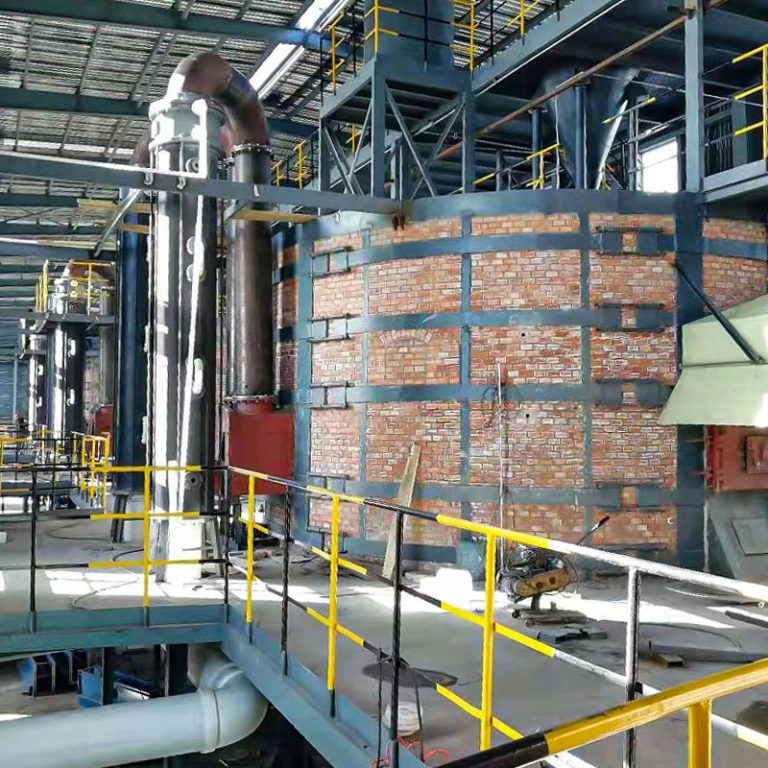
Cooling reduces product temperature before screening and packing, but the cooler can become a dust source when air leaks through a discharge seal. Keep the cooler under controlled negative pressure and return collected product only when its quality and temperature are known. Returning every collected fraction to the process can create a loop of fines.
Screens need a sealed cover, a correctly sized vent, and a safe method to remove oversize. If a screen is opened while the fan is off, dust can escape into the operator zone. Interlock access doors with the fan or provide a written isolation sequence that includes a settling time.
At packing, the bag mouth should be supported before filling starts. A short flexible sleeve, an extraction connection at the spout, and a separate route for rejected bags reduce the amount of powder released during changeover. Weighing systems should be enclosed without making scale checks impossible.
Housekeeping and Maintenance Design
Housekeeping is part of dust control, not a shift-end cosmetic task. Draw a vacuum route that reaches under conveyors, behind collectors, and around the bagging machine. Store hoses where they cannot be run across an emergency exit. Use a written inspection sheet with the same source-map labels used by the engineering team.
The maintenance plan should list gasket inspection, chute wear, flexible-sleeve replacement, fan vibration, filter differential pressure, hopper bridging, and pulse-air quality. A rising differential pressure may mean loaded bags, a blocked discharge, or a failed pulse valve. A falling pressure can mean a torn bag or an open access door. Operators need both interpretations.
Commissioning Tests That Matter
Before product introduction, verify fan rotation, damper position, air direction, interlocks, emergency stops, and collector discharge. Smoke tests around a hood can show whether air enters the enclosure or spills into the room. Use a controlled, approved test material before testing with the actual fertilizer.
During production trials, record collector pressure, fan current, product temperature, screen load, packing rate, and visible leakage. Walk the same route at low, normal, and high throughput. A workshop that looks clean at half rate may lose capture when a second packing head starts.
The acceptance record should identify test conditions. “Dust collector passed” is not enough. State which equipment was running, which dampers were open, what filter pressure was observed, and who approved the result.
The workshop drawing should reserve space for a clean side and a dirty side of each collector. Operators then know where to bring replacement bags, where to place a sealed waste container, and which door must remain closed during a filter change. This small separation prevents maintenance work from becoming a new dust release.
Lighting deserves the same attention. Put fixtures above transfer points and inside service platforms, but keep them outside the dusty air path where possible. A dark inspection door is often left open because an operator cannot see a buildup. Better visibility supports both safety checks and faster cleaning.
Data to Give the Equipment Supplier
Provide product type, particle-size range, moisture, temperature at each transfer, expected fines, throughput, operating hours, cleaning method, utilities, building elevations, and local ventilation rules. Include the intended route for collected dust and any restrictions on returning it to product.
Buyers can compare fertilizer production equipment und contact the project engineering team with this data. Hebei Aoliande Chemische Ausrüstung Co., LTD. can then define collection points, ducting, access platforms, and commissioning boundaries around the actual process conditions rather than a generic workshop drawing.
Schlussfolgerung
A low-dust fertilizer workshop starts with a source map and ends with measurable airflow, accessible collectors, and a housekeeping route that operators can follow. Enclosed transfer points, balanced extraction, controlled pressure, and clear maintenance duties keep dust from becoming a building-wide problem. The best design makes the clean action the easy action.
Häufig gestellte Fragen
What creates the most dust in a fertilizer workshop?
Open transfer points, chute drops, screening, bag filling, and dry spill cleanup are common sources. Their severity depends on product temperature, fines, moisture, and throughput.
Should a workshop use compressed air for cleaning?
Compressed air often redistributes settled fertilizer dust. A suitable industrial vacuum and a planned cleaning route are easier to control.
How can a dust collector be checked during production?
Trend differential pressure, fan current, hopper discharge, visible leakage, and the condition of pulse-air valves. Compare readings with a known clean baseline.
Can collected fertilizer dust be returned to the process?
Only after checking its chemistry, moisture, temperature, and particle size against the product specification and the process mass balance.