
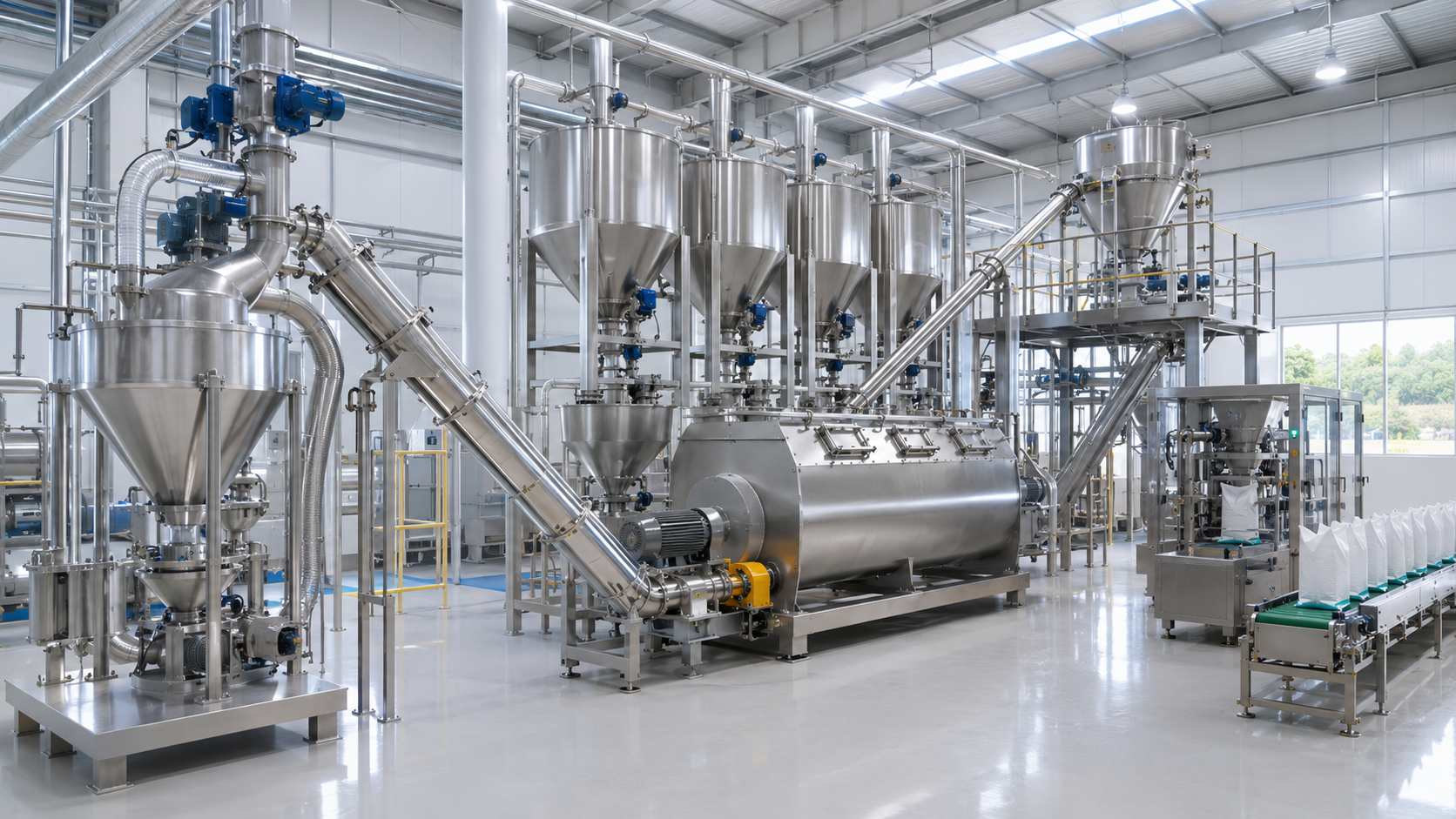
A water soluble fertilizer workshop can become dusty within days if powder handling is left open. Dust is more than a dirty floor. It can mean raw material loss, formula deviation, worker exposure, sticky equipment, dusty bags, and higher moisture absorption before the product reaches growers or distributors.
A low-dust fertilizer workshop is built as a complete flow. Feeding, closed conveying, automatic batching, mixing, packing, airflow, and cleaning access must work together. In a water soluble fertilizer production line, the target is stable dosing, uniform mixing, and clean finished bags.
Why Dust Control Matters in Water Soluble Fertilizer Production
Water soluble fertilizer formulas often include urea, potassium salts, trace elements, chelated nutrients, humic materials, amino acid materials, and other powders with different flow behavior. Some flow easily; others absorb moisture fast or become sticky in humid air.
Dust creates cost and quality risk
A few kilograms of escaped powder per shift can become a real monthly loss. If a fine micronutrient escapes at the feeding or weighing point, the batch may look normal but perform poorly in drip irrigation, foliar feeding, or soilless cultivation.
Dust also adds daily labor. Operators spend more time sweeping floors, wiping electrical cabinets, cleaning bag surfaces, and clearing transfer points. A cleaner workshop gives visiting buyers more confidence.
Map the Dust Sources Before Buying Equipment
A good workshop layout starts with a dust map. Follow the material from raw material entry to finished product storage and mark each place where powder falls, turns, or meets moving air.
| Dust source | Common problem | Practical control |
| Bag dumping | Powder cloud near operators | Dust-free feeding station |
| Transfer point | Side leakage and spillage | Closed conveying or covered chute |
| Weighing hopper | Fine powder loss | Sealed hopper and flexible connection |
| Mixer inlet | Dust surge during charging | Covered inlet and controlled feeding |
| Packing spout | Dusty bags and floor buildup | Bag clamping and local extraction |
This step prevents a common mistake: buying a large dedusting system while leaving open transfer points across the line. Several small controls at the right points often work better than one oversized collector.
Start with Dust-Free Feeding
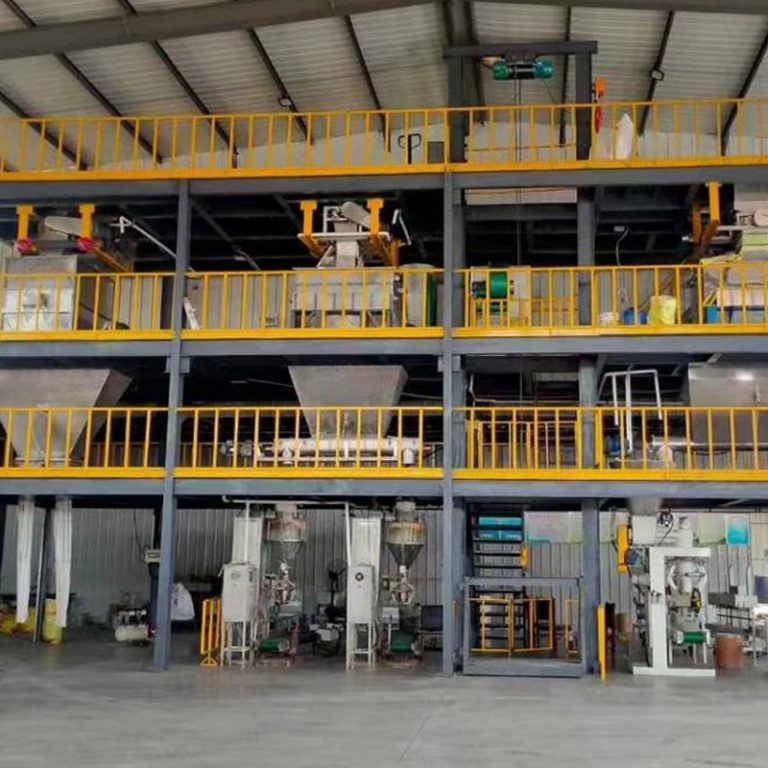
Feeding is often the dirtiest part of a powder fertilizer production line. A safer feeding point should pull dust away from the operator and move powder quickly into the next closed section.
What a safe feeding point needs
A practical dust-free feeding area usually includes a bag support platform, feeding hood, screen or grate for bag fragments, and a connected dust collector. The inlet size matters: too large, and suction weakens; too small, and operators shake bags harder.
For water soluble fertilizer production, fast feeding also helps reduce moisture contact. When raw materials enter a closed hopper quickly, the workshop stays cleaner and the formula is less likely to change before weighing.
Use Closed Conveying for Powder Fertilizer Handling
Open conveying looks simple, but it often brings leakage, spillage, and extra cleaning. A closed conveying system keeps material inside the line and reduces contact with humid air.
Match the conveying method to the material
Screw feeding is commonly used when the line needs controlled powder movement during measuring. It gives steady feeding and works well with automatic batching. Pneumatic or vacuum conveying may suit longer distances or compact layouts, but it must match the powder’s bulk density, particle size, and moisture behavior.
Flexible connections between hoppers, conveyors, weighing bins, and mixers also matter. They reduce leakage, absorb vibration, and stop powder from drifting into motors and walking areas.
Design Batching and Mixing for Accuracy
Automatic batching is where dust control and formula accuracy meet. A water soluble fertilizer production line may switch between NPK, drip irrigation, foliar, and crop-specific blends. Each formula depends on repeatable weighing.
Static weighing and controlled feeding
A well-built automatic batching system uses static measuring to improve dosing stability. Fast feeding moves most of the material quickly, while slow feeding brings the final weight close to target. This reduces overshoot.
If a weighing hopper leaks dust, the lost powder may not return to the batch. Sealed hoppers, screw feeding, and flexible interfaces help keep the formula inside the process instead of on the floor.
Mixer details buyers should check
Mixing decides whether each bag carries the same nutrient value. A horizontal double ribbon mixer is widely used in fertilizer mixing because it moves material in different directions and reaches uniform blending in a short time.
A mixer for water soluble fertilizer should have a covered inlet, suitable discharge valve, smooth internal surfaces, and access points for cleaning. If the discharge valve leaves dead corners, old material can contaminate the next batch. Fast mixing also reduces open-air time, moisture absorption, and caking.
Control Dust at the Packing Area
Packing is the final production step, but it is often the first thing buyers notice. A dusty bag sends the wrong message.
Clean filling, clamping, and sealing
An automatic quantitative packaging system should measure, clamp the bag, fill, seal, and convey the bag forward with little powder escape. Pneumatic bag clamping reduces leakage around the filling mouth, electronic weighing supports stable bag weight, and stainless steel contact parts make cleaning easier.
For 10 kg, 20 kg, or 25 kg bags, packing speed must match upstream batching and mixing. If packing is too slow, finished material waits too long; if filling is too aggressive, dust rises from the bag mouth.
Plan the Workshop Layout for Cleaning and Moisture Control
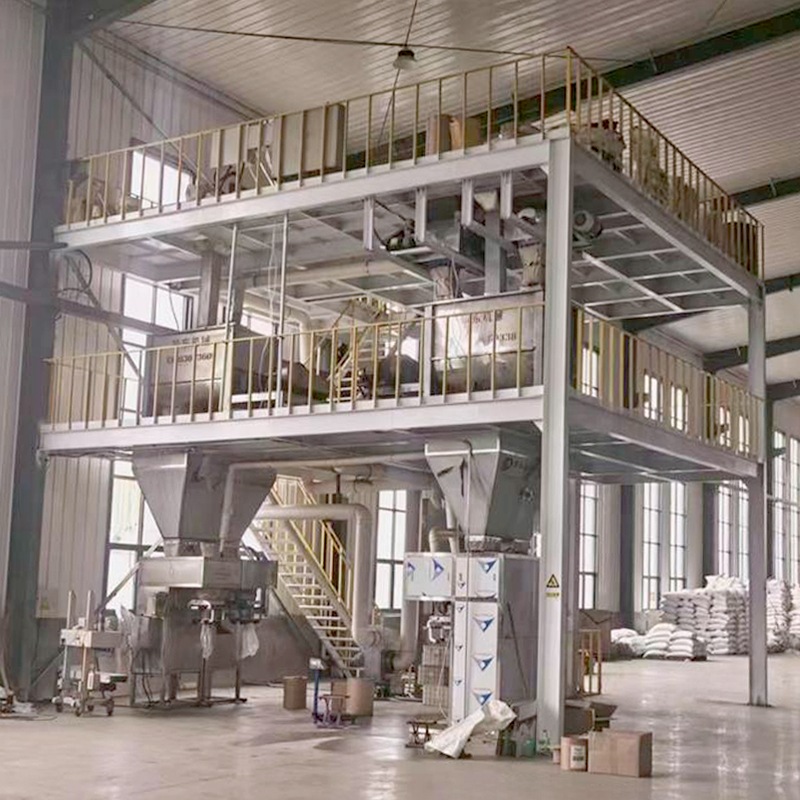
A low-dust fertilizer workshop needs a simple material route. Raw materials should move forward from feeding to batching, mixing, packing, and finished product storage. Cross-flow creates extra handling and more spillage points.
Useful layout rules include:
- Keep drop heights as short as practical.
- Separate raw material opening from finished bag storage.
- Leave cleaning space around mixers, conveyors, and packing machines.
- Control humidity where powders wait in hoppers or bins.
- Use corrosion-resistant and easy-clean contact materials where needed.
Material choice matters. Manganese steel, 304 stainless steel, 316L stainless steel, or customized steel can be selected according to corrosion, cleaning method, and budget.
Key Equipment for a Low-Dust Water Soluble Fertilizer Line
A complete water soluble fertilizer production line usually links raw material conveying, automatic batching, mixing, weighing, filling, sealing, and finished product conveying.
| Equipment section | What to check before purchase |
| Dust-free feeding | Suction point, operator height, screen, cleaning access |
| Raw material conveying | Sealing, corrosion resistance, transfer height |
| Automatic batching | Static weighing, fast and slow feeding, formula storage |
| Horizontal ribbon mixer | Mixing evenness, discharge valve, cover design |
| Packing system | Weighing accuracy, bag clamping, filling control |
Before requesting a layout, buyers should prepare raw material names, formula count, target output, bag size, humidity conditions, and workshop dimensions. These details shape the layout, automation level, and cleaning access.
Hebei Aoliande Chemical Equipment Co., LTD. as a Supplier
Hebei Aoliande Chemische Ausrüstung Co., LTD. supplies industrial production equipment for chemical and fertilizer plants, including Water Soluble Fertilizer Production Line solutions. The company has manufacturing capability as well as design ability for materials, structures, and production equipment. Its water soluble fertilizer line covers feeding, batching, mixing, and automatic packing, with configurations adjusted to raw material type, formula quantity, output target, package size, and plant space.
For buyers planning a new plant or upgrading a dusty workshop, this background is useful because dust control depends on both machine selection and process layout. Technical advice, equipment supply, transportation support, and installation guidance can reduce trial-and-error.
Schlussfolgerung
The low-dust workshop is not the outcome of only one piece of equipment but rather a combination of controlled feeding, closed conveying, sealed batching, uniform mixing, clean packaging, airflow regulation, and easy cleaning. In the case of water soluble fertilizer manufacturing, all of these factors contribute to the maintenance of proper formulation, minimize the raw material consumption, and provide clean appearance of the finished bags.
Customized water soluble fertilizer manufacturing line will enable you to move dust reduction from your list of everyday concerns to an established process.
Häufig gestellte Fragen
How do you reduce dust in fertilizer production?
Dust can be reduced by using dust-free feeding, closed conveying, sealed hoppers, flexible equipment connections, local dust collection, and controlled packing. The best result comes when each dust source is handled at the process point.
What would be the best dust capturing system for fertilizer powder?
This question cannot be answered since different powders require different systems. Fine and dry material will require more effective local dust capturing system and better sealing. Hygroscopic material will benefit from reduced exposure, smooth transferring, and humidity control.
Why is closed conveying system important for water soluble fertilizer manufacturing line?
With closed conveyor, there is less risk of powder leakage, material is not exposed to humid air, and reduces cleaning at transfer points. Closed conveying system also provides for better weighing accuracy.
Can low-dust workshop design help prevent caking?
Yes. Caking is linked to raw material quality, moisture, storage time, and exposure to air. Low-dust design shortens open handling time, supports sealed transfer, and helps control humidity.